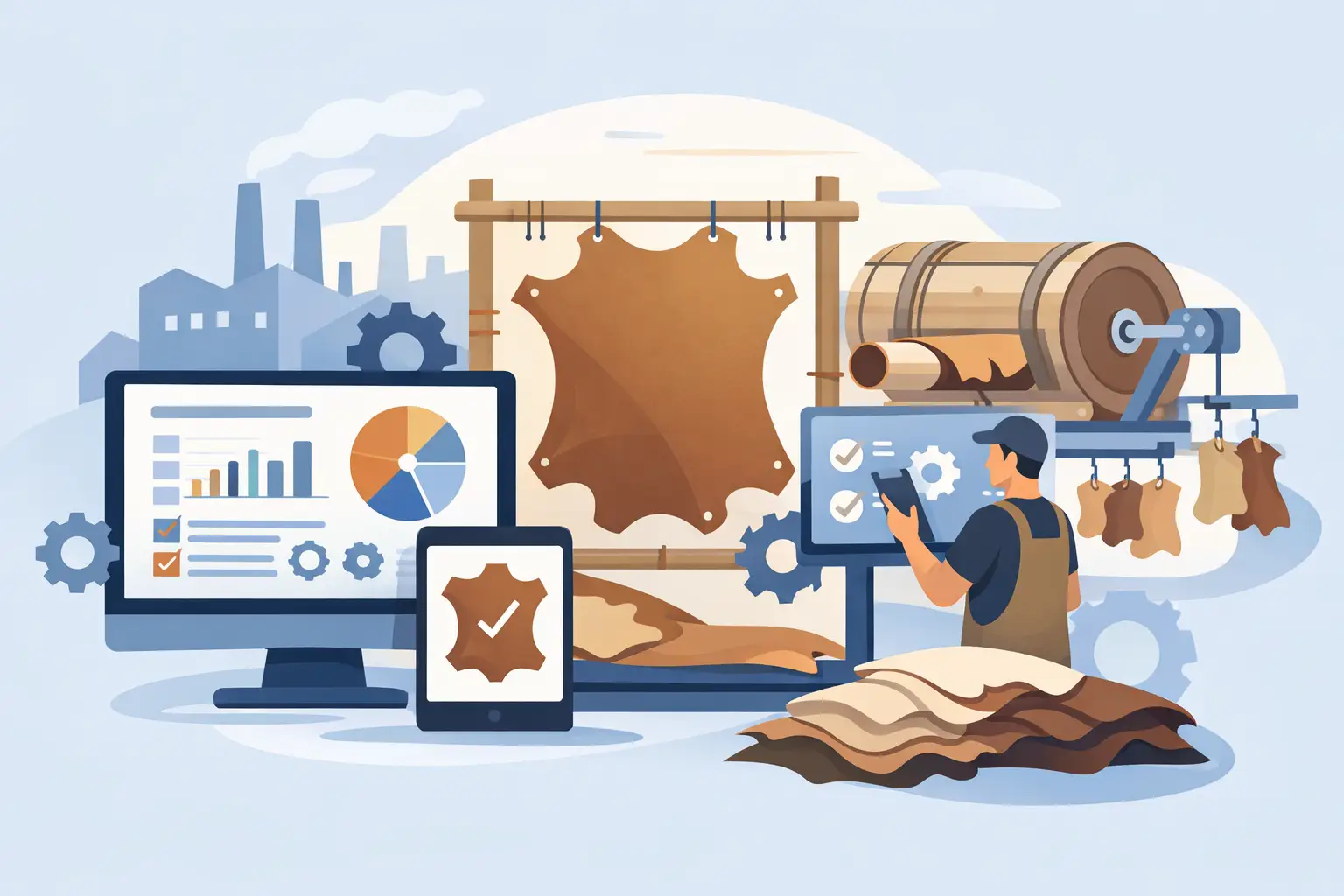
A batch can look profitable when it enters the tannery and become a costly surprise by finishing. Hides vary, chemical usage moves quickly, rework is not always recorded, and stock may sit between wet blue, crust and finished goods with no clear owner. Leather tannery production management software brings those moving parts into one operating view, so managers can see what happened to each batch, what it cost and what needs attention next.
For tannery owners and production teams, the issue is rarely a lack of data. The issue is that data sits in batch cards, spreadsheets, weighbridge records, chemical stores, laboratory notes, accounting software and the knowledge of experienced floor staff. A connected ERP platform turns that information into practical control without making daily production harder to run.
Why tanneries need connected production control
Leather production is a process business with material variability at every stage. The quality, weight, grade and origin of raw hides influence chemical recipes, processing time, yield and the quality of the final leather. A standard manufacturing system that only records finished quantities can miss the details that determine margin.
Tannery operations also have long and interdependent production routes. Receiving, sorting, soaking, liming, fleshing, splitting, tanning, sammying, shaving, retanning, dyeing, drying, staking and finishing may be managed across different teams and machines. A delay in one area can affect drum availability, work-in-progress, delivery commitments and cash tied up in stock.
The right system should connect production planning with purchasing, inventory, quality, maintenance, labour and finance. Instead of asking multiple people for an update, an operations manager can review planned versus actual output, batch status, available chemicals, machine capacity and production costs all in one place.
What leather tannery production management software should manage
The best fit depends on the tannery’s products, scale and level of process automation. A business producing consistent automotive leather has different traceability needs from a tannery processing smaller fashion, upholstery or footwear runs. Still, several capabilities are fundamental.
Batch traceability from hide to finished leather
Every batch should have a digital history. This starts with raw hide receipting, supplier details, origin, weight, grading and inspection results. As material moves through each process, the system records transfers, splits, regrades, wastage, yields and resulting quantities.
Traceability is not just a compliance exercise. When a customer raises a quality question, the team needs to identify the relevant batch, its recipe, machine run, operator notes and test results quickly. This also makes it easier to isolate affected material rather than placing a broad hold on finished stock.
Where the operation handles customer-owned materials, the system should clearly separate customer stock from company-owned inventory. That distinction protects billing accuracy and prevents stock from being allocated incorrectly.
Recipe, chemical and process management
Chemical consumption is one of the most material cost drivers in a tannery. Production management software should maintain approved recipes by leather type, grade, thickness, colour and process stage. It should issue materials against production orders, calculate expected quantities from batch weight or area, and show actual consumption against plan.
This creates a useful control point. If chemical usage rises beyond the expected tolerance, managers can investigate whether the cause is a recipe change, operator adjustment, poor raw material quality, incorrect weighing or stock-recording errors. The goal is not to remove skilled judgement from the process. It is to record adjustments and understand their cost and quality effect.
Lot tracking for chemicals and dyes is equally valuable. It supports quality investigations, expiry management and controlled substitution where an approved alternative is available.
Work-in-progress, yields and production costs
Work-in-progress is often where tannery profitability becomes unclear. Raw material is converted through several stages, but financial systems may only see purchases and eventual sales. A production system should value inventory at each stage and allocate direct materials, labour, machine time and relevant overheads to the batch.
Yield reporting helps teams measure what each process is producing. Depending on the product, this may include hide weight, square footage, square metres, thickness, selection grade and rejected area. Managers can compare actual yields against standards by supplier, leather type, batch, shift or production route.
There is a trade-off here. Overly detailed data entry can slow floor teams down and reduce adoption. The practical approach is to capture high-value transactions automatically where possible and keep manual screens focused on exceptions, quality results and genuine decisions.
Inventory, purchasing and customer delivery
Production planning only works if material availability is trustworthy. The system needs current stock by warehouse, location, lot, quality status and production stage. Chemical stores, raw hides, semi-finished leather, finished goods and packaging should not be managed as separate islands.
When a sales order is confirmed, planners should be able to check available finished stock, committed quantities and capacity to produce the balance. Material requirements can then drive purchasing suggestions for hides, chemicals and consumables. Finance teams gain a clearer view of commitments, landed costs, stock values and expected margins before the order is dispatched.
For tanneries with multiple warehouses or outsourced process steps, transfer orders and subcontracting records are essential. The business needs to know not just that stock has left the site, but where it is, what work is expected and when it should return.
Turning machine data into usable decisions
Many tannery processes depend on drums, sammying lines, drying equipment and finishing machinery. Machine or PLC connectivity can capture run times, temperatures, cycles, water usage, alarms and downtime directly from equipment. This reduces manual recording and provides a more reliable picture of actual production conditions.
The value comes from connecting this data to the batch. If a colour variation or quality defect appears, the team can compare process parameters with previous successful runs. If a drum is regularly delaying production, maintenance and planning teams can see the operational impact rather than treating it as an isolated engineering issue.
Not every tannery needs full machine integration from day one. A smaller operation may begin with digital batch recording, inventory and costing, then add PLC feeds to its highest-volume or highest-risk equipment. A staged implementation is often more practical than trying to automate every process at once.
Quality, environmental reporting and carbon accountability
Tanneries operate under close scrutiny for quality, chemical handling, water use and waste. A connected platform can build inspection points into the production route, recording test results, defects, approvals, corrective actions and material holds. It can also maintain certificates, supplier documentation and customer-specific specifications against relevant products or batches.
Environmental reporting should be treated as an operational tool, not a year-end administrative burden. Capturing water, energy, chemical and waste data alongside production volumes makes it possible to monitor resource intensity by batch or product family. Carbon accounting can then provide a clearer basis for internal improvement programmes and customer reporting.
Data quality matters. Carbon calculations are only as useful as the source records behind them, so the best starting point is accurate purchasing, utility, production and waste information. Businesses can add more sophisticated emissions factors and reporting rules as their data maturity grows.
Choosing a platform that fits the tannery
A suitable platform must be configurable enough to reflect the tannery’s actual terminology, process stages, approvals and costing methods. Generic production workflows that force a business to change valid operational controls can create workarounds rather than improvement.
Look for a cloud ERP that combines financial accounting, inventory, purchasing, sales, production planning and reporting in one system. It should support mobile-friendly transaction entry for the factory floor, role-based access for production and finance teams, and audit trails for critical changes. Power BI analytics can give management tailored dashboards for yield, quality, stock ageing, margin, capacity and environmental measures.
Security and implementation support also deserve attention. Production data, customer specifications, recipes and pricing are commercially sensitive. A managed platform with defined user permissions, backup processes, monitoring and cybersecurity support can reduce risk while easing pressure on internal IT teams.
OneBusiness can configure these connected workflows for leather operations, combining standard ERP functions with production, machine-data, analytics and industry-specific requirements. The priority is not adding technology for its own sake. It is giving every team a clearer, faster way to make sound production decisions.
A tannery does not need perfect data before it can improve control. Start with the batches, costs and stock movements that create the most uncertainty, build reliable routines around them, and let the system make each next decision easier to see.