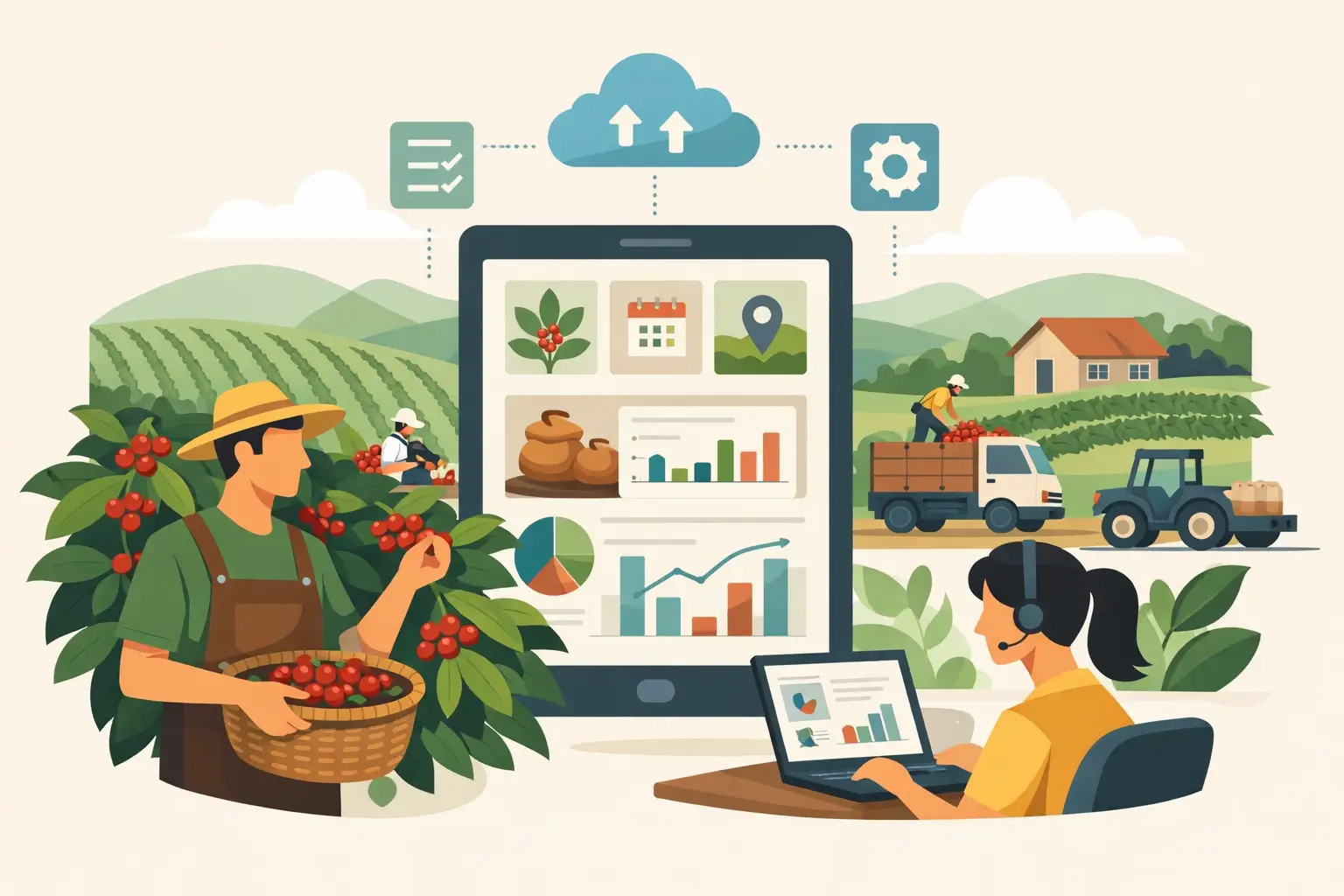
A coffee harvest can lose control before the first ute reaches the processing area. Pickers arrive across multiple blocks, bins are weighed in quick succession, cherry quality varies by location, and supervisors need answers before the day’s intake is complete. Coffee plantation harvest management software brings those moving parts into one operating system, connecting field activity with labour, inventory, processing, finance and management reporting.
For plantation businesses, the goal is not simply to replace paper tally sheets. It is to know which block produced each load, who picked it, what it cost, where it went after intake and whether the result met the expected quality and margin.
Why harvest data needs to move faster
Harvest is a compressed operating window. Decisions that could wait a week in the off-season often need to be made before the next morning’s picking round. A wet-weather delay, a labour shortage, an unexpectedly high intake from one block or a quality issue at receival can affect processing capacity and delivery plans immediately.
Spreadsheets can record totals, but they struggle when data arrives from field teams, weighbridge staff, warehouse operators, processing supervisors and payroll administrators at different times. Duplicate entries become common. A bin may be identified by a handwritten note, while its related labour record sits elsewhere. Finance then receives a batch of costs that cannot easily be tied back to a block, variety, customer order or processing run.
A connected system gives operations and finance teams the same operational truth. Supervisors can view daily intake and picker productivity, while owners can see labour, transport, processing and stock costs without waiting for month-end reconciliation.
What coffee plantation harvest management software should connect
The best approach is to treat harvest management as part of the wider business, not a standalone farm app. Coffee moves from a growing area through intake, processing, storage, grading, sales and dispatch. Each handover should retain the data collected before it.
Block-level harvest records
The starting point is a clear plantation structure. The software should support estates, farms, blocks, varieties, planting areas and harvest seasons in a format that reflects the way the business operates. Field supervisors need to allocate teams and tasks against the relevant block, then record quantities harvested by date, picker or crew.
This detail enables more useful analysis than a single daily tonnage figure. Management can compare yield against expected output, identify blocks requiring follow-up and assess whether harvesting activity is occurring at the right maturity stage. Where connectivity is limited, mobile-first workflows or offline data capture can be particularly valuable, with records synchronised once the team returns to coverage.
Labour, contractor and payment controls
Labour is often one of the largest and most variable harvest costs. Depending on the operation, workers may be paid by day, by weight, by bin, by task or under a combination of arrangements. The system needs configurable rate rules and approval steps so that a supervisor’s field record can become a verified payroll or contractor payment input.
That does not remove the need for oversight. Weight-based incentives can encourage speed at the expense of quality if the rules are poorly designed. A practical workflow records picker output alongside quality checks, rejected loads and attendance. It gives managers a fairer basis for resolving disputes and protects the business from paying against incomplete or inaccurate records.
Weighing, intake and quality assessment
Receival is where traceability either becomes reliable or breaks down. Each delivery should be recorded with its source block, picker or crew, gross and tare weight, net cherry weight, date, time and receiving location. Barcode labels, QR codes, mobile devices or integrated scales can reduce manual re-entry and make the process quicker during peak intake.
Quality data should sit alongside quantity. This may include ripeness, foreign material, moisture where relevant, visual defects, rejection reasons and the destination processing batch. The exact fields depend on the plantation’s practices and whether it produces washed, natural, honey or other coffee profiles. Configurable forms matter because a rigid template rarely suits every estate or processing method.
From cherry intake to saleable inventory
Coffee does not become saleable stock at the weighbridge. It changes state through pulping, fermentation, washing, drying, hulling, grading and packing. Every conversion can create yield loss, by-products, rework or quality variation. If these movements are recorded outside the main system, stock valuation and production costing quickly become estimates.
Coffee plantation harvest management software should link harvest lots to production batches and inventory locations. The business can then track cherry into parchment, green bean or finished packed stock, depending on its operating model. Warehouse teams gain clearer visibility of stock on hand, stock committed to orders, lots awaiting quality release and material held at each site.
This is especially useful when a business handles coffee from several farms or purchases additional cherries from growers. Company-owned harvest and third-party intake need to be distinguishable from the first transaction. Otherwise, production reports can look accurate in volume while hiding significant differences in sourcing cost, quality and profitability.
Make harvest costs visible before month end
A harvest total is not a performance measure on its own. Higher output may be positive, but not if overtime, transport, rejected fruit or processing losses rise faster than revenue. The operational value of an ERP platform is its ability to bring direct field costs and downstream costs together.
A well-configured system can allocate labour, contractor payments, fertiliser or crop inputs where appropriate, transport, fuel, processing labour, packaging and overheads to the relevant farm, block, batch or product. Finance teams retain proper accounting controls while operations leaders see the commercial effect of daily choices.
For example, a manager may find that two blocks delivered similar volumes but sharply different cost per kilogram of green bean after processing. That result may point to access issues, picker performance, fruit maturity, transport distance or lower conversion yield. The software does not make the agronomic decision, but it provides the evidence needed to make it with confidence.
Use reporting to plan the next picking round
Reports should answer operational questions, not merely reproduce transaction data. Daily dashboards can show harvested quantity versus target, intake by block, crew productivity, rejection rates, available processing capacity and stock by stage. Power BI reporting can extend this view with trends by season, estate, variety, supplier and customer.
Forecasting also benefits from timely field records. Historical yield, current harvest pace, weather observations and processing throughput can help managers estimate labour needs, storage requirements and likely sales availability. AI and machine learning can assist with pattern detection and forecasting where data quality is strong, but they are not a substitute for sound field records. Poorly captured weights and inconsistent block codes will produce poor forecasts, no matter how advanced the analytics layer is.
Carbon reporting is another growing consideration for coffee businesses supplying customers with environmental reporting expectations. Tracking fuel, transport, energy use, processing activity and inventory movement within connected workflows gives the business a more credible base for carbon accounting than an annual exercise built from scattered invoices.
Integration should solve a real bottleneck
Not every plantation needs complex automation on day one. A smaller operation may begin with mobile harvest entry, basic lot traceability, labour allocation and inventory control. A larger processor may require scale integration, label printing, machine or PLC connectivity for processing equipment, automated production records and multi-site reporting.
The right scope depends on harvest volume, number of sites, labour model, processing complexity and customer traceability requirements. It is usually better to establish dependable master data and clear receival processes first, then add integrations where they remove a proven delay or source of error.
For organisations replacing accounting software, separate inventory tools and spreadsheets, an all-in-one ERP can reduce repeated data entry across teams. OneBusiness can configure plantation, production, finance, warehouse and reporting workflows around the way a coffee operation actually runs, rather than asking staff to reshape every process around generic software.
How to implement without disrupting harvest
Timing matters. A full rollout during the busiest weeks of harvest can create unnecessary risk, particularly if staff are learning new receival or labour procedures under pressure. Many businesses prepare block structures, product codes, rate rules, supplier records and reporting requirements before the season, then introduce the most critical workflows in a controlled pilot.
Start with the transactions that affect traceability and payment: harvest record, weigh-in, quality check, lot creation and labour approval. Once these are stable, bring in processing production orders, detailed cost allocation, mobile field forms, sales forecasting and advanced dashboards. Training should be role-based. A field supervisor needs a fast, practical screen; a finance manager needs controls, audit trails and reconciliation visibility.
Security also deserves attention. Harvest and payroll data is commercially sensitive, and access should be limited by role and location. Cloud delivery, managed security services, audit logs and sensible approval workflows help protect records without making everyday work difficult.
The real test of the system comes at the end of a busy day: can a manager trace a lot from block to intake, see its quality result, understand its cost and decide what to do next? When that answer is yes, harvest management becomes less about chasing paperwork and more about running the plantation with control.
Coffee Plantation Management for End-to-End Agricultural Operations
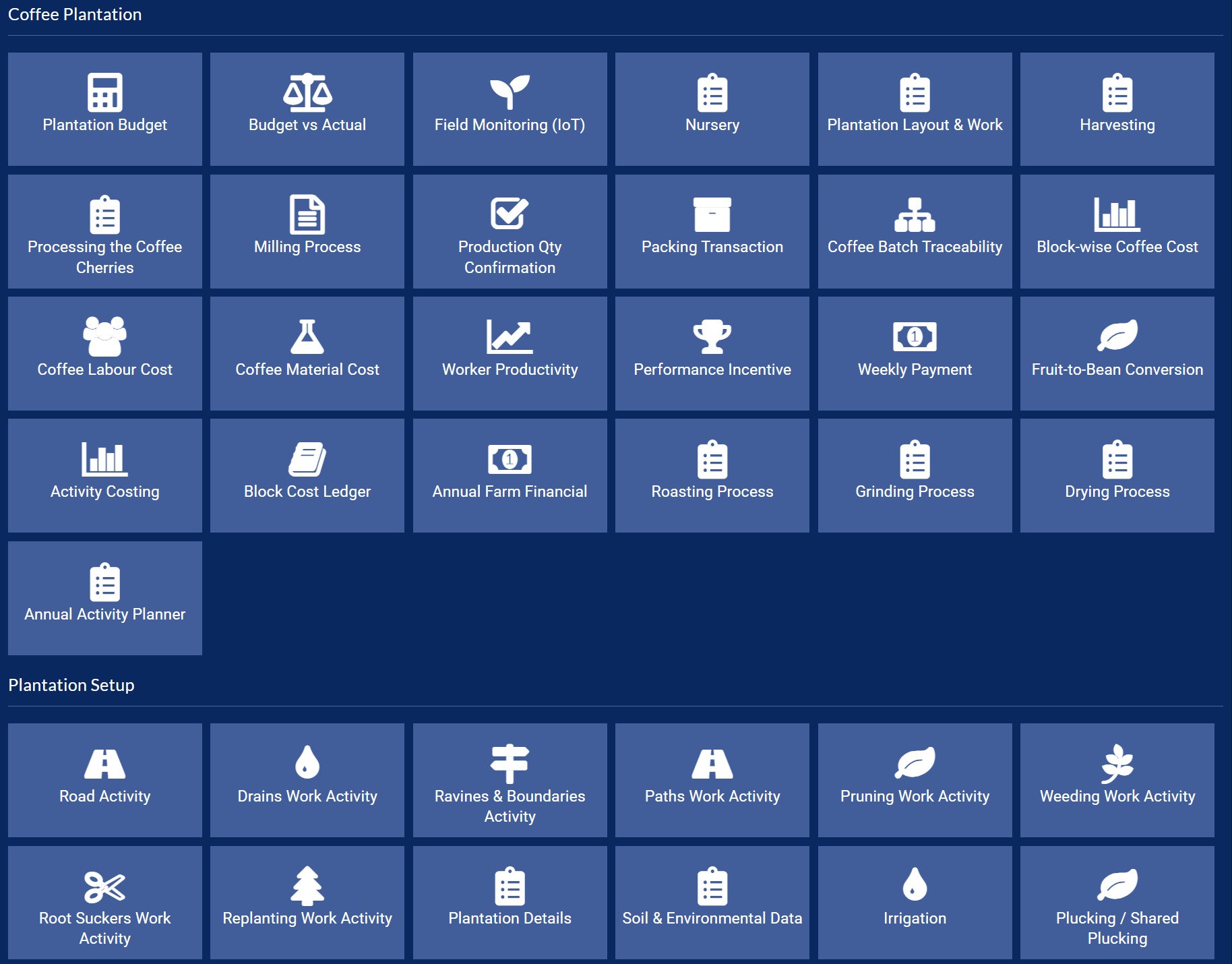
OneBusiness ERP provides coffee plantation harvest management software that connects plantation budgeting, cultivation, harvesting, processing, and financial management in a single platform. The process begins with Plantation Budget and Budget vs Actual, allowing organizations to define planned plantation expenses and compare them with actual spending. Plantation and crop information can then be captured through the Nursery module, including plant and seed details. Using Plantation Layout & Work, organizations can create and manage estates, fields, and blocks while recording geographical coordinates to maintain a structured view of plantation areas. The system also supports the recording of plantation activities such as irrigation, weeding, pruning, replanting, manuring, pest and disease control, mechanical harvesting, and other field activities, providing a centralized record of work performed across the plantation.
The coffee plantation harvest management software supports the complete coffee production flow, starting with Harvesting and continuing through Processing the Coffee Cherries, Drying, Milling, Roasting, Grinding, Production Quantity Confirmation, and Packing. Coffee batches can be tracked through these stages to maintain visibility from harvested coffee to finished production. Production Quantity Confirmation captures the actual production output and supports the calculation of production costs based on the materials and activities involved. The system can also support fruit-to-bean conversion, helping organizations track how harvested coffee quantities are converted into processed coffee output. With Coffee Batch Traceability, businesses can maintain batch-level visibility throughout the production process and connect production information with inventory and other ERP transactions.
Beyond production management, coffee plantation harvest management software provides detailed cost and performance visibility across plantation operations. Organizations can capture and analyze block-wise and batch-wise material costs, labour costs, production costs, and other activity-related expenses. The Block Cost Ledger provides a consolidated view of costs associated with individual plantation blocks, while Performance Incentive functionality can support incentive calculations based on worker performance and productivity. Worker Productivity, Weekly Payment, Coffee Labour Cost, and Coffee Material Cost further help plantation managers monitor labour utilization and operational expenses. By bringing plantation activities, harvesting, processing, costing, traceability, and financial information together, OneBusiness ERP provides a connected platform for managing coffee plantation operations from budget → nursery → plantation layout → field activities → harvesting → processing → milling → production → costing → reporting.