

A late dispatch is rarely caused by one dramatic failure. More often, the problem starts with a pallet received into the wrong location, a stock count that was not updated, a pick list printed from yesterday’s data, or a customer order promised before available inventory was confirmed. A warehouse management system brings these moving parts into one controlled process, so warehouse teams, sales staff and finance teams are working from the same information.
For Australian businesses managing growth across manufacturing, trading, retail, processing or labour-intensive operations, the warehouse is not simply a storage area. It affects cash flow, customer service, production schedules and margins. The right system gives teams practical control over what has arrived, where it is held, what is committed, what needs replenishing and what can be dispatched now.
What a warehouse management system should control
A warehouse management system, often called a WMS, manages the movement and storage of goods from receiving through to dispatch. Its value is not just knowing how many units are on hand. It creates a dependable record of each stock movement and guides people through the work in the right sequence.
At receiving, staff can match delivered goods against purchase orders, record quantities, identify damaged items and allocate stock to a bin, rack, bay or production holding area. Rather than treating the warehouse as one broad stock location, the system can show the precise location of each item. This matters when staff need to find stock quickly or separate quarantine goods, returns, customer-owned stock and saleable inventory.
During fulfilment, the system can create pick tasks based on sales orders, stock location and delivery priority. It can also control packing, labels, despatch documentation and inventory adjustments. For businesses with multiple sites, it should record transfers without creating uncertainty about where stock sits while it is in transit.
The real benefit comes from connecting these actions to the wider business. When a warehouse receipt updates stock, purchasing can see what has arrived, production can see available materials, sales can confirm realistic delivery dates and finance can maintain an accurate view of inventory value.
Why inventory visibility alone is not enough
Many growing businesses already have inventory figures in accounting software or spreadsheets. The issue is that a total stock number does not explain whether the stock is usable, where it is located or whether it has already been allocated to another order.
Consider a manufacturer with 2,000 kilograms of a key material recorded in stock. If 800 kilograms are on quality hold, 700 kilograms are committed to a production order and 300 kilograms are at another site, the apparent balance is misleading. Operations needs an available-to-promise figure, not just an on-hand number.
A well-configured system separates the stock states that matter to the business. These may include available, allocated, in inspection, damaged, returned, in production, in transit and consignment stock. The categories should reflect real operating decisions rather than software for software’s sake.
Traceability is equally important. Batch, serial and expiry tracking can be essential for food processing, agricultural products, regulated goods, spare parts and high-value equipment. When an issue arises, teams need to identify affected stock, its supplier or production batch, and every customer order involved without spending days searching paper records.
Warehouse management system features that deliver daily value
The most useful features are the ones warehouse staff will use every shift. Complexity does not automatically create control. A system must match the way goods physically move through the operation while introducing enough discipline to prevent costly workarounds.
Location and bin control
Location control turns a warehouse map into operational data. Each item can be assigned to a warehouse, zone, aisle, rack, shelf or bin, depending on the level of detail required. A small trading business may only need warehouse and bin locations. A high-volume distributor or manufacturer may require zones for receiving, put-away, picking, packing, quarantine and despatch.
This reduces dependence on individual staff knowledge. When an experienced storeperson is away, the next person can locate stock using the system rather than searching every rack.
Mobile scanning and guided work
Barcode scanning reduces manual keying and confirms that the right item has been received, picked or transferred. Mobile devices can guide staff through receiving, put-away, cycle counting and dispatch tasks in real time.
Scanning is not essential in every warehouse from day one. For lower volumes, a carefully managed desktop workflow may be enough. But as order numbers, product lines or warehouse staff increase, mobile scanning generally pays for itself through fewer picking errors, faster transactions and more reliable stock records.
Replenishment and cycle counting
A warehouse should not wait for an annual stocktake to discover discrepancies. Cycle counting lets teams count selected items, locations or high-value materials throughout the year. This spreads the workload and identifies recurring causes of variance, such as damaged stock, incorrect units of measure or unrecorded production consumption.
Replenishment rules can also flag stock that is approaching minimum levels or suggest transfers between locations. These settings need commercial judgement. A generic reorder point may create excess stock if supplier lead times, seasonal demand or production plans are not considered.
Order allocation and fulfilment priorities
When inventory is limited, the system needs clear allocation rules. It may reserve stock for confirmed customer orders, production jobs, key accounts or a scheduled retail replenishment run. Without this discipline, staff can unknowingly pick stock that has already been promised elsewhere.
The best rule depends on the business. First-in, first-out may suit standard trading stock, while expiry-based picking is more appropriate for perishable products. Project-based businesses may need materials reserved by job, and manufacturers may allocate scarce components to the highest-priority production order.
Connecting warehouse activity to production and finance
A standalone WMS can improve warehouse accuracy, but it can still leave teams reconciling data across systems. For operationally complex businesses, the stronger approach is to connect warehouse control with purchasing, sales, production, accounting and reporting in one platform.
In manufacturing, material issues should flow to work orders so managers can compare planned consumption with actual usage. Finished goods receipts should update available inventory and provide a clear view of production output. Where machinery or PLC data is available, production activity can be captured alongside warehouse transactions, giving operations teams a more complete picture of throughput, downtime and material yield.
For finance, inventory movements have direct consequences. Receipts, adjustments, transfers, production consumption and dispatches affect inventory valuation, cost of goods sold and margin reporting. If warehouse data is delayed or maintained separately, month-end reporting becomes a reconciliation exercise rather than a management tool.
This is where a connected ERP platform has practical advantages. OneBusiness combines warehouse and inventory workflows with financial accounting, sales, billing, production planning and Power BI reporting, allowing teams to examine stock, cost and operational performance in the same environment.
Choosing the right level of warehouse control
Not every business needs the same warehouse management system. Over-configuring the solution can slow adoption, while under-configuring it leaves the original problems untouched. The right design starts with the operational questions your team needs answered each day.
A business with one warehouse and a modest product range may prioritise accurate receiving, bin locations, stock reservations and simple replenishment. A multi-site distributor may need transfer workflows, handheld scanning, customer-specific stock, picking waves and carrier-ready dispatch processes. A processor or manufacturer may require batch traceability, quality holds, production staging, by-product handling and expiry controls.
Before selecting or configuring a system, map the physical journey of goods. Follow one purchase order from arrival at the dock through checking, put-away, picking and dispatch. Then follow one material through production and one customer return back into the warehouse. The gaps between those real-world steps and the current records will show where automation and controls are needed.
It is also worth deciding who owns each transaction. Warehouse teams should not be expected to resolve purchasing mismatches without a clear approval process, and sales teams should not promise stock without visibility of allocations. Good system design makes responsibilities visible rather than shifting issues between departments.
Implementation habits that protect adoption
Warehouse system projects succeed when they focus on clean operational foundations. Start by standardising item codes, units of measure, warehouse locations and stock statuses. If the product master contains duplicates, unclear descriptions or inconsistent pack sizes, no amount of scanning will produce trustworthy results.
Test the processes using realistic scenarios before go-live: short deliveries, damaged goods, partial picks, substitute items, urgent orders, stock transfers and returns. Train staff on why each scan or confirmation matters, not just which button to press. This is particularly important when experienced staff have built efficient informal methods over many years.
After go-live, monitor a small set of meaningful measures: inventory accuracy, pick accuracy, order turnaround time, stock adjustments, aged inventory and fulfilment performance. These figures reveal whether the new process is improving control or merely digitising old habits.
A warehouse management system earns its place when the warehouse becomes easier to run under pressure. When the next urgent order arrives, staff should be able to see what is available, find it quickly, dispatch it accurately and trust that every connected team is seeing the same result.
Structured Warehouse & Storage Management
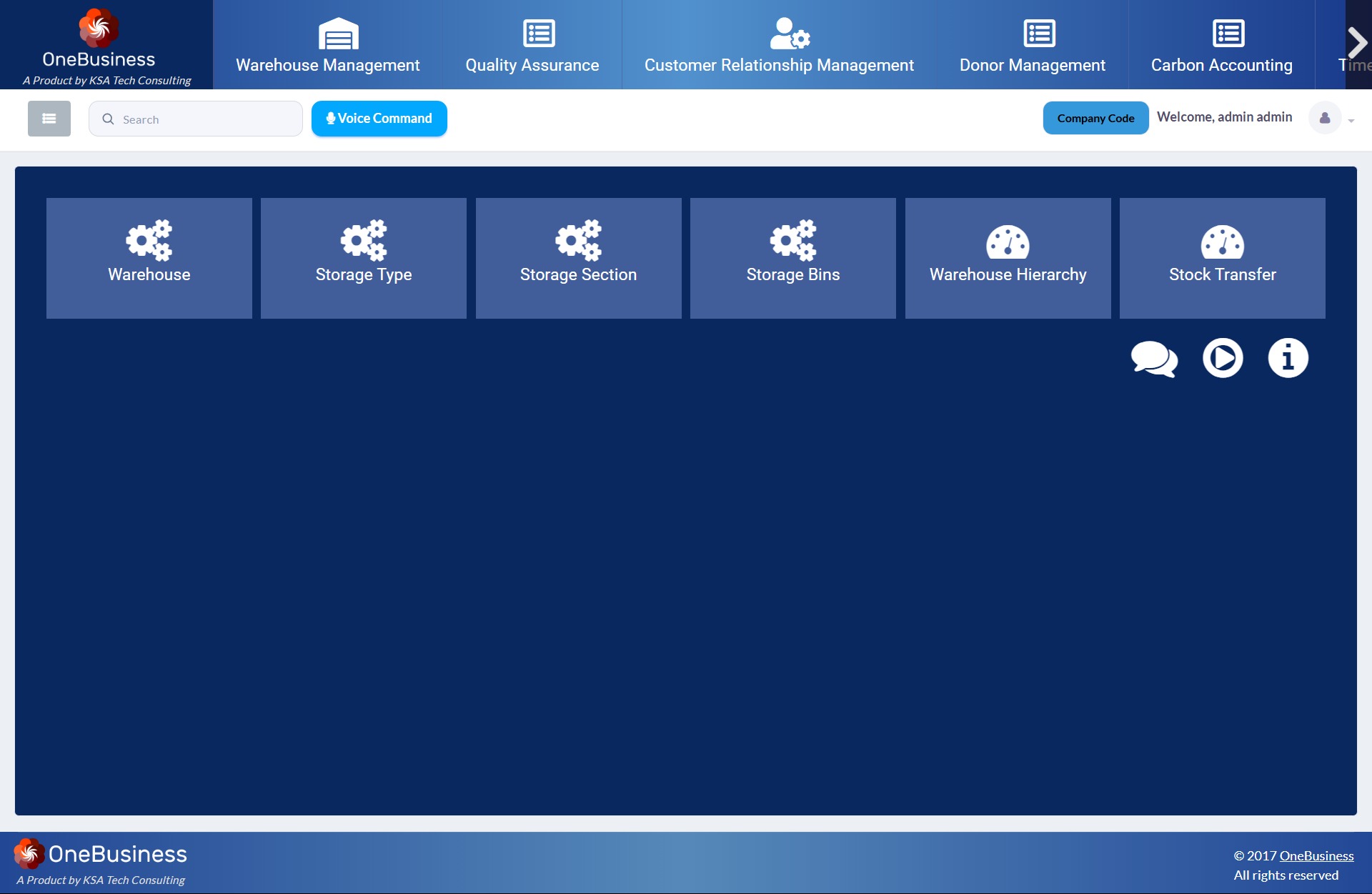
The Warehouse Management Module in OneBusiness ERP provides a structured framework for managing the organization’s complete warehouse and inventory hierarchy. It allows users to configure and maintain multiple plants, storage locations, warehouses, storage sections, and storage bins under a single company code. This hierarchical structure provides a clear representation of the physical storage environment, making it easier to organize inventory and maintain stock at the appropriate level. The system also supports stock tracking across each level of the hierarchy, providing greater visibility and control over inventory. The warehouse hierarchy in OneBusiness ERP provides a structured view of plants, warehouses, storage sections, and storage bins, as illustrated below.
The module is fully integrated with inventory-related transactions across procurement, sales, and other business processes. Users can drill down into a specific plant, warehouse, storage section, or storage bin to view the opening balance, stock movements, and closing balance of materials. This provides real-time visibility into where inventory is stored and how stock levels change across different locations, enabling organizations to improve inventory accuracy, warehouse control, and overall supply chain management.