
A warehouse team can have stock on the shelf while sales is told it is unavailable. Finance may have paid for materials that production cannot locate. A retail manager may reorder a popular line because the spreadsheet says there are only three left, when 40 units are sitting at another site. These are not simply stock-count problems. They are signs that the business is working from disconnected information.
For businesses assessing inventory management software Australia offers plenty of options, from simple cloud stock apps to full enterprise resource planning platforms. The right choice depends less on the number of stock features on a sales page and more on how inventory moves through your operation: purchasing, receiving, warehousing, production, sales, invoicing, dispatch and financial reporting.
Why inventory control becomes an operational issue
Inventory is where commercial decisions meet physical work. A purchasing officer needs accurate demand and supplier lead times. The warehouse needs clear receiving, put-away, picking and transfer processes. Production needs confidence that the right materials are available before a job starts. Finance needs stock valuation and cost movements to match the general ledger.
When each team works in a separate system, those connections rely on exports, emails and manual updates. This creates delay, duplicate entry and uncertainty. Staff spend time investigating why figures differ rather than acting on what the figures mean.
The effect is especially visible in operationally complex Australian businesses. A manufacturer may manage raw materials, work in progress, finished goods, offcuts and batches. A food processor may require lot traceability, expiry controls and yield reporting. A wholesaler may transfer stock between warehouses and manage customer-specific pricing. A hospitality operator must control recipe ingredients while keeping service moving. In each case, a basic stock-on-hand figure is useful, but it is not enough.
Good software provides a shared operational record. It shows what is physically available, what is committed to orders, what is on purchase order, what is being consumed in production, and what value sits in inventory. That visibility supports better planning without requiring every team to maintain its own version of the truth.
For Australian businesses, inventory management software Australia solutions can help connect purchasing, warehousing, production, sales and finance through a single operational record.
What inventory management software Australia businesses should connect
The right inventory management software Australia businesses select should connect the complete stock lifecycle, from purchasing and receiving through to production, sales, dispatch and financial reporting.
The most valuable inventory management software Australia businesses can choose is usually not a standalone inventory platform. It is the one that connects stock control to the workflows that cause stock to move.
Purchasing and receiving
Purchase orders should create a clear record of expected stock, supplier pricing and delivery dates. When goods arrive, receiving staff need a practical way to check quantities, record discrepancies, assign lots or serial numbers where required, and direct stock to the right warehouse or bin.
For businesses importing goods or managing variable freight costs, the system should also support a sensible approach to landed costs. Otherwise, margin reporting can look healthy until the real cost of getting stock to site is considered.
Effective inventory management software Australia businesses use should connect purchase orders, receiving, supplier pricing and delivery dates in one workflow.
Sales, billing and fulfilment
Sales teams need available-to-promise stock, not a headline quantity that ignores existing allocations. Once an order is confirmed, the system should reserve or allocate inventory according to the organisation’s rules. Warehouse users then need pick, pack and dispatch processes that are quick enough for daily work, not an administrative burden that staff work around.
The connection to billing matters as well. When sales, dispatch and invoicing are separate, a business can ship goods without promptly invoicing them or invoice items that have not left the warehouse. A connected workflow provides control at both ends.
Production and machine data
For manufacturers and process-based businesses, inventory software needs to go beyond receiving and dispatch. Bills of materials, production orders, material issue, finished goods receipt, scrap and by-product handling all affect stock accuracy and product cost.
There is a meaningful difference between planned consumption and actual consumption. If a production run uses more chemical, fabric, timber or packaging than expected, that variance should be visible. Where appropriate, connecting industrial machines or PLC data can bring a more accurate view of run times, output and material usage into the operating system. This is not necessary for every business, but for high-volume or tightly controlled production it can reduce manual records and improve traceability.
Finance, analytics and compliance
Inventory decisions affect cash flow, profitability and tax reporting. Stock valuation, cost of goods sold and adjustments need to flow into financial accounting without a separate reconciliation exercise at month end. This is one of the strongest arguments for an ERP platform over a disconnected stock application.
Operational dashboards can then bring purchasing, sales, stock turns, slow-moving lines, production variance and margins together. Power BI reporting is particularly useful when managers need to compare locations, product groups, customers or time periods without waiting for a manually prepared report.
Some organisations also need to report on environmental impact. Carbon accounting capabilities can help connect operational activity and inventory movements with emissions data, although the value depends on the sector, reporting obligations and the quality of source data.
How to assess inventory management software Australia businesses can use every day
When evaluating inventory management software Australia options, test the platform against actual transactions rather than relying only on a feature checklist or product demonstration.
A feature checklist is a starting point, not a decision. The practical test is whether the system supports real roles and real exceptions in your business.
Begin by mapping one item from purchase through to sale or consumption. Include every handover: supplier order, goods received, quality check, storage, transfer, production issue, pick, dispatch, invoice, return and adjustment. This often reveals where the current process depends on someone remembering to update a spreadsheet.
Then test prospective software with your own scenarios. Ask how it manages split deliveries, damaged stock, substitutions, customer returns, negative stock, stocktakes, partial production completion and inter-warehouse transfers. If you operate with batches, serials, expiry dates, multiple units of measure or consignment stock, make these non-negotiable demo cases rather than assumptions.
Ease of use deserves close attention. A system can have excellent controls on paper but fail when warehouse and production teams find it too slow or complicated. Mobile-friendly screens, barcode scanning options, clear permissions and straightforward approval workflows make correct processing more likely. The aim is not to add steps. It is to put the right controls into the work already being done.
Security and support should be assessed with the same care as functionality. Understand where data is hosted, how user access is managed, what backup and recovery arrangements apply, and who responds when an issue affects operations. Managed cybersecurity services can be valuable for businesses without a large internal IT function, but responsibilities should be clear from the outset.
Avoid buying for the business you used to be
A low-cost inventory app can be a sensible fit for a small trading business with one location, a simple catalogue and limited reporting needs. It may be unnecessary to implement a broad ERP system before the operation is ready.
The trade-off changes when stock interacts with manufacturing, projects, labour, multiple entities, retail point of sale or detailed financial reporting. Adding a new tool for every requirement can appear cheaper at first, yet it often creates more integrations and reconciliation work over time. The cost is not only subscription fees. It is the time staff spend checking which number is correct.
Look for configuration before custom development. Configurable workflows, forms, approval rules, reporting fields and industry modules allow the platform to match the business without making future upgrades difficult. Customisation still has a place for specialist workflows, especially in plantations, industrial processing, garment washing or labour hire, but it should solve a real operational need rather than reproduce an outdated habit.
Plan implementation around clean data and adoption
Software will not correct unreliable item masters, inconsistent units of measure or unlabelled warehouse locations by itself. Before go-live, establish sensible item naming, stock categories, bins, opening balances, supplier records and costing rules. Decide who can create new items, approve adjustments and change product information.
Rollout should also reflect operational risk. Some businesses benefit from starting with purchasing, receiving and core stock control before adding production or advanced analytics. Others need the complete flow live together because partial integration would create more manual work. The right path depends on transaction volume, internal capability and how tightly inventory is connected to finance and production.
Training works best when it is role-based and practical. A storeperson, production supervisor, sales coordinator and finance manager do not need the same lesson. Each should understand the tasks they perform, the data they are responsible for and the reports they can use to make better decisions.
For growing Australian organisations, inventory management software in Australia should provide enough flexibility to support additional warehouses, products, users, transactions and reporting requirements as the business expands.
OneBusiness is designed for organisations that need these workflows in one connected cloud platform, combining inventory and warehouse control with finance, sales, production planning, analytics and configurable industry processes.
Stay connected with KSA Tech Consulting on LinkedIn and Facebook for the latest ERP updates, insights and solutions.
The best inventory system is not the one with the longest feature list. It is the one that gives your people confidence to receive, make, move, sell and report on stock without chasing information across disconnected tools. Start with the movements that create the most friction, then choose a platform that can grow with the operation you are building.
End-to-End Inventory Control & Visibility
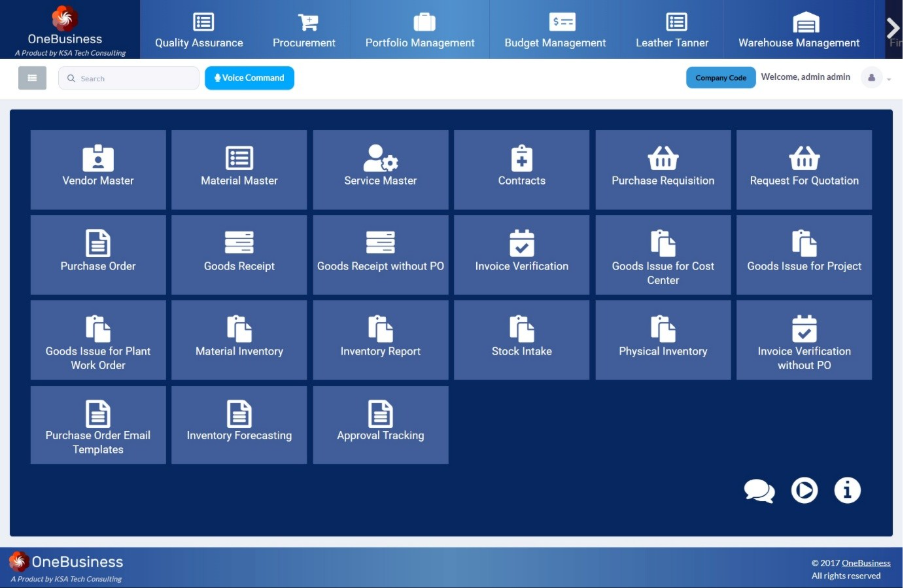
The Inventory Management submodule, available under the Procurement module in OneBusiness ERP, provides centralized visibility and control over the movement and availability of materials across the organization. The Inventory Report tracks the complete lifecycle of stock, including materials received through procurement, materials issued for production, materials transferred or consumed through other business processes, and goods sold through sales transactions. Users can filter inventory information by material and storage location to monitor stock receipts, production consumption, sales, stock intake, utility consumption, and current stock balances, providing a consolidated view of inventory movement and availability.
The module also supports critical inventory activities during ERP cutover and go-live through the Stock Intake functionality, which allows organizations to upload their existing inventory as opening stock and assign it to the appropriate company, plant, warehouse, storage location, storage section, and storage bin. Accounting entries are maintained for these inventory transactions to ensure that inventory values are properly reflected in the financial accounts. The Physical Inventory submodule enables users to perform physical stock verification and make authorized inventory adjustments, with corresponding accounting entries maintained for the changes. In addition, Inventory Forecasting helps organizations anticipate future material requirements and stock levels, supporting better procurement planning, production planning, and inventory optimization.