A job can leave the factory floor on time, meet its quality standard and still lose money. The usual reason is not one dramatic error. It is a series of small costs that were never captured properly: extra material issued from stores, machine downtime, rework, overtime, energy use or a production run that yielded less than expected. Production costing makes these costs visible while there is still time to act.
For operational businesses, accurate costs are not simply an accounting requirement at month end. They shape selling prices, purchasing decisions, production schedules, inventory values and investment choices. When finance, warehouse and production teams work from different spreadsheets or disconnected systems, leaders often receive a margin report after the opportunity to improve it has passed.
What production costing should tell you
Production costing is the process of assigning the full cost of making a product, batch or work order. It brings together direct materials, direct labour and manufacturing overheads, then compares the expected cost with what actually occurred.
The result should answer practical questions. What did this batch really cost? Which product line is delivering margin? Did a material price increase flow through to finished goods? Did a particular machine, shift or process create avoidable cost? Can the business accept a customer order at the quoted price?
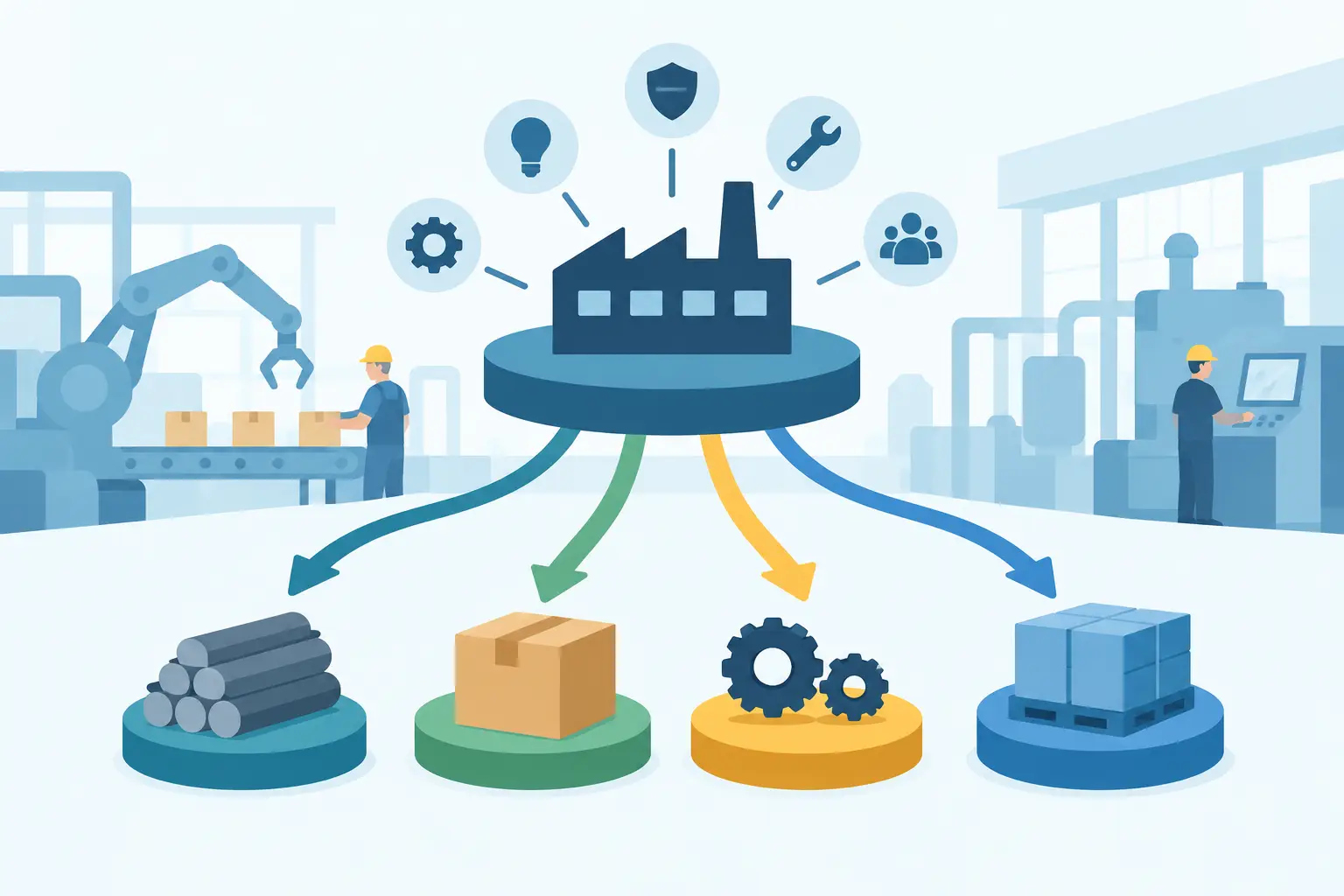
A useful costing model follows the path of work through the operation. Materials are received, inspected and issued to a job. Labour is recorded against the relevant operation. Machines consume time, electricity and maintenance resources. Finished goods are completed into stock, while incomplete work remains visible as work in progress. If any of those events are captured late or outside the system, cost accuracy falls quickly.
The three cost layers that matter
Direct material is normally the clearest starting point. It includes the raw ingredients, components, packaging and consumables that become part of the product. In a garment washing operation, this may include garments, chemicals, labels and cartons. In a food or process plant, it may include raw inputs, additives and packaging. The challenge is not only knowing the purchase price. It is also managing wastage, substitutions, batch traceability and yield.
Direct labour covers the people doing the work. It may be measured by hours, units completed, shift time or a combination of these. A business with manual timesheets can estimate labour cost, but estimates become unreliable when employees move between jobs, assist with rework or spend time waiting for materials or machine availability. Capturing labour against the correct work order creates a far more useful view of production efficiency.
Overheads are often where margins become distorted. Rent, utilities, depreciation, supervision, quality checks, maintenance and indirect labour must be allocated across production in a reasonable way. Some businesses allocate overhead by labour hours; others use machine hours, output volume or activity-based drivers. There is no universal answer. A highly automated operation may get a more truthful result from machine-hour allocation, while a labour-intensive workshop may rely more heavily on labour hours.
The aim is not to create a perfect mathematical model that no one can maintain. It is to use cost drivers that reflect how resources are genuinely consumed and can be reviewed as the operation changes.
Standard cost versus actual cost
Most businesses need both standard and actual costs. A standard cost is the planned cost of producing an item, based on its bill of materials, routing, expected labour time and overhead rates. It supports quoting, budgeting, production planning and stock valuation.
Actual cost records what was consumed in the real production run. The gap between standard and actual is the variance, and it is where management action begins. A material variance might point to supplier price changes, inaccurate recipes or higher scrap. A labour variance may show slow cycle times, training needs or poor job sequencing. An overhead variance can reveal low capacity utilisation or an outdated allocation rate.
Not every variance is a problem. A short run may legitimately cost more per unit because setup time is spread across fewer units. A premium material may be approved for a high-value customer order. The important point is that the reason is visible, documented and reflected in decision-making rather than buried in a general ledger account.
Build costing into the daily workflow
The strongest production costing process is part of normal operational work, not a separate monthly exercise for the finance team. It begins with disciplined master data: item records, units of measure, bills of materials, routings, work centres and cost rates need clear ownership and regular review.
When a production order is released, the system should provide the expected material and labour requirements. Warehouse staff can issue or backflush components, depending on the level of control required. Operators can record completed quantities, scrap, downtime and labour time as work progresses. The business can then see work in progress and emerging variances before the batch is closed.
The right level of detail depends on the industry. A make-to-order engineering business may need job-level costing for each customer project. A process manufacturer may need batch costing with lot traceability, yield measurement and co-product handling. A plantation or agricultural processor may track harvest input, transport, processing loss and grade outcomes. Recording every minor activity may create administration without insight, while recording too little makes the numbers unusable. The design should match the commercial decisions the business needs to make.
Connect the shop floor to finance
Disconnected systems are a common cause of unreliable production costs. Purchasing may know the latest supplier invoice price, but production is using an old spreadsheet bill of materials. Warehouse stock may be adjusted manually, but finance does not see the impact until month end. Machine data may show downtime, but it is not connected to the work order or maintenance record.
A connected ERP platform reduces these gaps by bringing purchasing, inventory, production, payroll or labour data, sales and accounting into one operational record. With suitable PLC or machine integration, production counts, cycle times and downtime can also be captured from equipment rather than manually re-entered after a shift. That improves timeliness, but it still requires sound process rules. Automated data is valuable only when product codes, work orders and exception handling are properly configured.
For example, a production manager might see that a batch is consuming more chemical input than its standard. The system can show whether the issue relates to a particular lot, machine setting, operator shift or finished-goods yield. Finance can assess the margin impact immediately, while procurement can review supplier quality or price exposure. This is far more useful than discovering a broad adverse variance weeks later.
Production costing reports leaders can use
A good costing report should lead to a decision, not just display numbers. Gross margin by product, customer or channel helps commercial teams protect profitable sales. Work-in-progress ageing identifies jobs that have stalled and are tying up cash. Material usage and scrap reports expose process loss. Labour and machine efficiency reports help supervisors plan capacity and improve throughput.
Variance reporting is particularly powerful when it is focused. Rather than asking teams to review hundreds of low-value differences, set practical thresholds for cost, percentage variance and production volume. A Power BI dashboard can combine these measures with sales demand, stock availability and machine performance so leaders can identify the highest-impact issue first.
There is also a compliance and sustainability dimension. Accurate material and energy records support traceability, audit readiness and carbon accounting. Businesses do not need to treat carbon data as a separate exercise if relevant consumption data is already captured at the point of production. The same operational discipline that improves cost visibility can improve environmental reporting.
Where businesses commonly go wrong
The first mistake is treating bills of materials as static. Prices, yield assumptions, packaging and approved substitutes change. If these updates are not governed, standard costs quickly lose credibility.
The second is relying on a single blended overhead rate for every product. It may be easy to administer, but it can overstate the cost of simple high-volume products and understate the cost of complex, low-volume work. Review whether the allocation basis still reflects the operation.
The third is closing production orders late. When work orders remain open for weeks, stock, work in progress and margins all become harder to trust. Clear rules for recording completions, scrap and exceptions are essential.
Finally, do not make production costing a finance-only project. Warehouse, production, maintenance, procurement and sales each create or use cost information. Their workflows need to be practical enough that accurate data is the easiest option.
OneBusiness can bring these operational records together in a configurable cloud ERP environment, giving teams a shared view of inventory, production, finance and reporting without relying on fragmented tools.
The most valuable next step is usually modest: choose one product family or production line, validate its bill of materials and routing, then compare standard cost with actual results for several runs. The gaps will show where better data, process control or system integration will deliver the strongest return.