
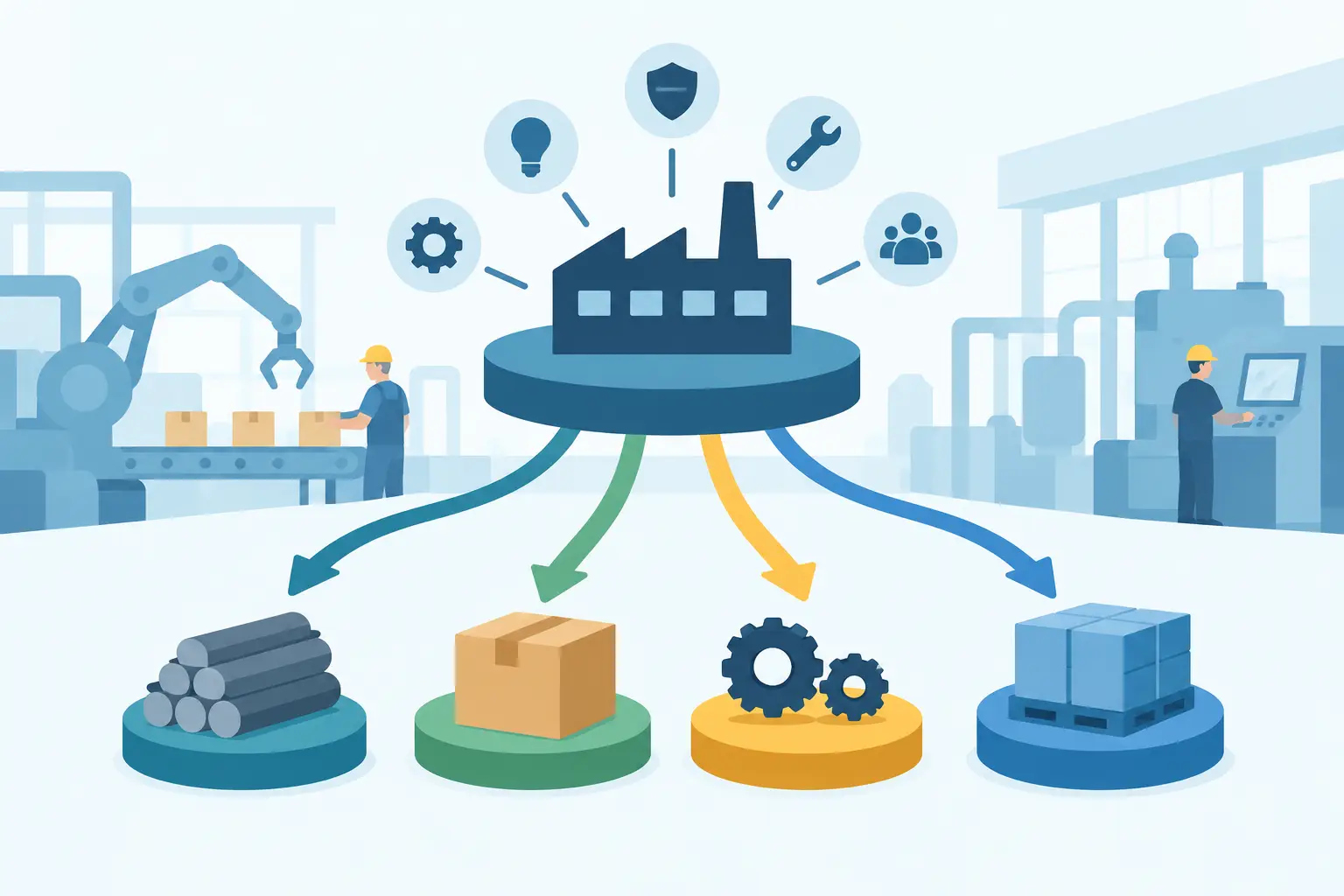
A production run can look profitable on the shop floor and still lose money once electricity, maintenance, supervision, depreciation and factory rent are counted. That is why learning how to allocate manufacturing overhead matters. It turns indirect factory costs into reliable product costs, giving finance and operations teams a clearer basis for pricing, planning and performance decisions.
Direct materials and direct labour are usually straightforward to assign to a job, batch or product. Manufacturing overhead is different. These costs support production but cannot be traced economically to one unit as it is made. The goal is not to make the allocation look precise for its own sake. It is to use a method that reflects how each product consumes factory resources.
What counts as manufacturing overhead?
Manufacturing overhead includes indirect production costs incurred to run the factory. Typical examples are factory rent, utilities, equipment depreciation, machine servicing, production supervision, quality support, indirect materials, cleaning, and the wages of staff who support several production lines.
It does not include selling, administration or distribution costs. Sales commissions, head-office salaries and delivery freight may be important expenses, but they are generally treated as period costs rather than production overhead. Keeping that boundary clear prevents product margins from being distorted.
For a small manufacturer, the allocation may start with a single monthly factory overhead pool. For a more complex operation with multiple processes, machines or departments, one pool can hide too much. A high-energy production line should not necessarily carry the same utility cost per hour as a manual assembly area.
How to allocate manufacturing overhead in five steps
1. Build an accurate overhead cost pool
Start by collecting the indirect costs associated with manufacturing for the period, usually a month, quarter or financial year. Use the general ledger as the financial starting point, then validate the figures with production and maintenance teams.
Separate costs that behave differently where practical. For example, factory rent may be a fixed cost, while power consumption and machine repairs may move with production activity. This distinction helps management understand why actual overhead differs from budget and whether an allocation rate still makes sense as volumes change.
It is also useful to create separate cost centres for major production areas, such as machining, finishing, packing and maintenance. A single company-wide pool is faster to manage, but departmental pools often produce better costing where resource use varies significantly.
2. Choose a cost driver that reflects resource use
A cost driver is the activity used to spread overhead across jobs or products. The right driver has a reasonable cause-and-effect relationship with the cost being allocated.
Direct labour hours can work well in labour-intensive manufacturing. Machine hours are generally more suitable where automation, equipment depreciation, maintenance and power make up a large share of overhead. In a process environment, production volume, kilograms processed, batches or run time may be more relevant.
Common drivers include:
- direct labour hours or direct labour cost
- machine hours
- units produced, batches or production runs
- material handling movements, set-ups or inspections
The easiest driver is not always the best one. Allocating overhead by labour hours in a highly automated factory can overcost labour-heavy products and undercost machine-intensive products. Conversely, using machine hours for a largely manual operation can create the opposite problem. Review the driver when the production mix, equipment base or process design changes.
3. Calculate a predetermined overhead rate
Most manufacturers use a predetermined overhead rate, calculated before or at the beginning of the period. This avoids waiting for final actual costs before costing work in progress and finished goods.
The basic formula is:
Predetermined overhead rate = Budgeted manufacturing overhead / Budgeted activity level
Suppose a manufacturer expects $600,000 in annual factory overhead and expects 30,000 machine hours. Its predetermined rate is $20 per machine hour.
$600,000 / 30,000 machine hours = $20 per machine hour
If Job A uses 18 machine hours, it receives $360 of manufacturing overhead. If Job B uses 70 machine hours, it receives $1,400. That allocated cost is added to direct materials and direct labour to calculate the job’s total manufacturing cost.
Using budgeted figures creates stability, but it also means actual results must be reviewed. A rate based on unrealistic volumes can materially misstate product costs. If demand falls sharply and fixed factory costs remain unchanged, overhead per unit will rise.
4. Apply the rate consistently to production records
Once the rate is approved, apply it to production orders using actual activity recorded for each job, batch or work order. The records need to be timely and credible. A machine-hour rate is only as good as the machine hours captured from operators, PLC data or production reporting.
This is where disconnected spreadsheets create avoidable work. Finance may hold the overhead budget, production may record time separately, and inventory may not receive the completed cost until days later. A connected ERP platform can bring production orders, labour entries, machine data, inventory movements and financial postings into one workflow.
For example, OneBusiness can connect operational data with accounting and production planning so teams can allocate costs from current activity rather than reconcile multiple systems at month end. The objective is practical control: clearer work-in-progress values, faster margin reporting and fewer manual adjustments.
5. Reconcile applied overhead with actual overhead
At period end, compare the overhead applied to jobs with the actual overhead incurred. The difference is either underapplied or overapplied overhead.
Underapplied overhead occurs when actual costs are higher than the amount applied to production. This may result from unexpected repairs, higher energy costs, lower production volume or an underestimated budget. Overapplied overhead occurs when more cost has been allocated than was actually incurred.
The accounting treatment depends on the size and cause of the variance, as well as the business’s financial reporting policy. Smaller balances may be adjusted through cost of goods sold. Larger amounts may need to be apportioned across work in progress, finished goods and cost of goods sold. More importantly, investigate the operational reason behind the variance. A recurring difference is a signal to revise the budget, activity forecast or allocation method.
When one overhead rate is not enough
A single factory-wide rate is suitable when products use similar processes and resources. It becomes less reliable when a business produces a varied mix of simple and complex products. A standard item made in long runs may need little set-up time or quality testing, while a customised order may require repeated changeovers, engineering input and inspections.
In this situation, departmental rates or activity-based costing can improve visibility. Departmental rates assign different overhead rates to different areas, such as fabrication and finishing. Activity-based costing goes further by assigning costs through several activities, such as machine set-ups, purchase orders, quality checks and material movements.
The trade-off is administration. More detailed allocation can improve decision-making, but only if the business can capture dependable activity data without burdening supervisors and operators. Start with the material cost drivers. Do not build a complicated model for costs that have little effect on product margins.
Common allocation mistakes to avoid
The most common mistake is treating an overhead rate as permanent. Rates should be reviewed at least annually and more often when energy prices, wages, factory capacity or production volumes move materially.
Another issue is mixing operating expenses with manufacturing costs. Including sales or administration expenses in factory overhead may make a product appear unprofitable when the real issue is commercial spending outside the factory. The reverse problem is leaving genuine factory support costs out of inventory values.
Teams also lose accuracy when they use planned activity instead of actual activity to apply the rate to individual jobs. Budgeted activity belongs in the denominator when setting the rate. Actual hours, units or batches should normally be used when applying that rate to a completed production order.
Finally, avoid using product cost as the only measure of performance. A product may absorb a fair share of overhead yet still be strategically worthwhile because it fills spare capacity, supports a key customer or enables a higher-margin product range. Costing informs the decision; it does not replace commercial judgement.
Turn overhead data into better operating decisions
A well-managed overhead allocation process gives more than an inventory valuation. It shows which products consume scarce factory capacity, where margins are eroding, and whether a pricing change is needed before the next quote goes out. It also supports more realistic budgets, production schedules and make-or-buy decisions.
Begin with a method your team can operate consistently, then improve the model as the data becomes stronger. When financial records, inventory, labour, machine activity and production orders are all in one place, overhead allocation becomes a regular management discipline rather than a month-end rescue job.