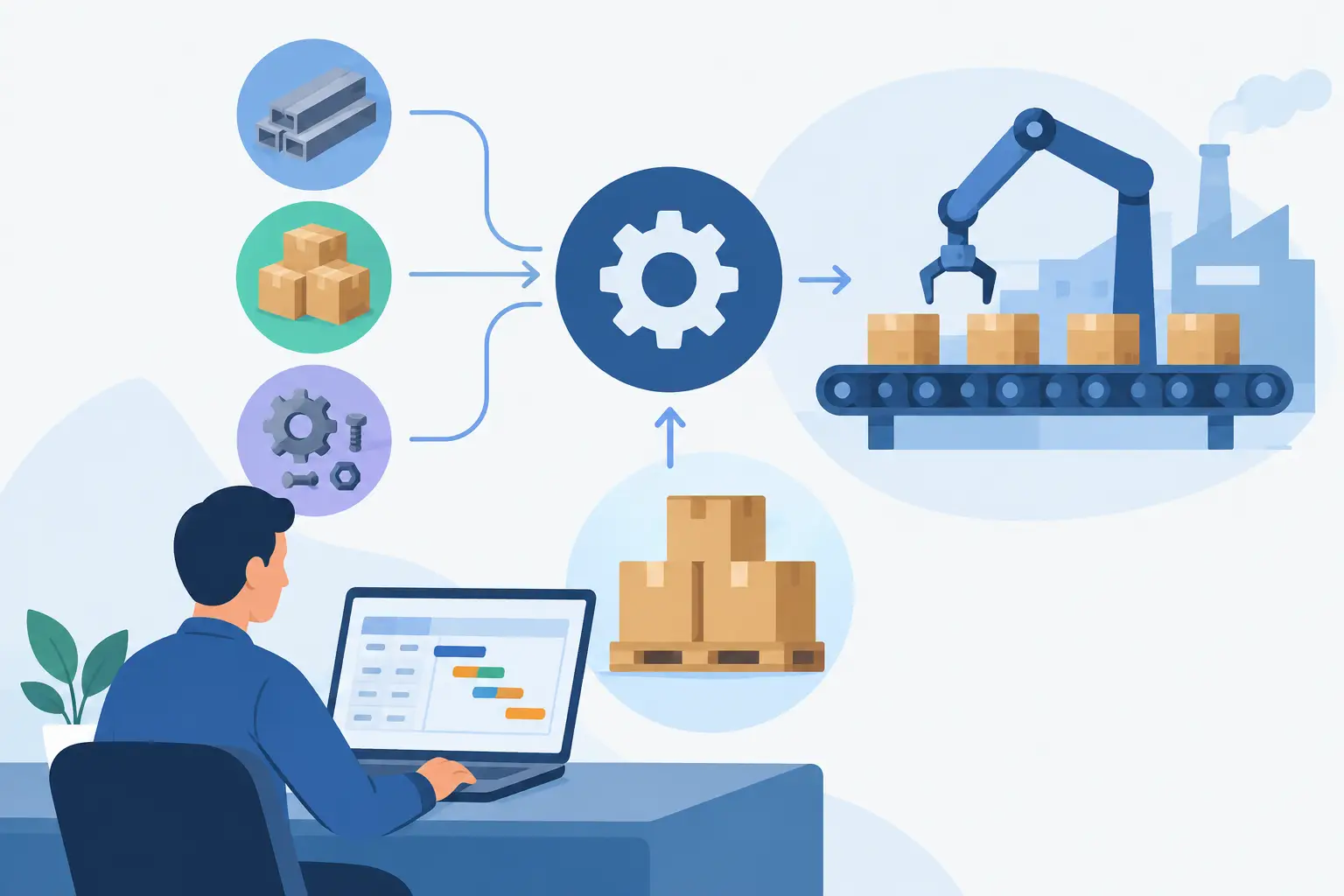

A production manager at a growing Australian manufacturer can often point to a full warehouse and still be unable to complete this week’s orders. The business has plenty of stock, but not the right stock in the right location at the right time. This inventory optimisation example shows how a connected ERP approach can reduce that problem without simply cutting stock levels and creating new supply risks.
The scenario is deliberately practical. It applies to manufacturers, processors, wholesalers and warehouse-led businesses that have outgrown spreadsheets, stand-alone accounting software and manual stock checks. The numbers will vary by industry, but the decisions behind them are widely relevant.
The inventory optimisation example
Consider a mid-sized manufacturer of commercial cleaning products in Melbourne. It produces concentrated liquid cleaners in 1-litre and 5-litre packs, supplying distributors, hospitality businesses and direct retail customers. The business holds raw chemicals, bottles, caps, labels, cartons and finished goods across a central warehouse and a smaller interstate distribution site.
Sales have increased by 18 per cent over the past year. That should be good news, yet the operation is under pressure. The finance team sees inventory value rising faster than revenue. The warehouse team is making frequent urgent transfers. Production is interrupted when a low-cost component such as a cap or label is unavailable. At the same time, several slow-moving finished products are approaching expiry.
Before optimisation, replenishment is mostly based on staff experience. The purchasing officer reviews a spreadsheet every Friday, checks supplier emails and places orders in rounded quantities. Production planners use last month’s sales as a guide. Sales staff can see customer orders, but they cannot always see reliable available-to-promise stock.
This process is not careless. It is a common response when systems are disconnected. The issue is that the business is making decisions from delayed and incomplete information.
Start with the operational baseline
The manufacturer begins by bringing sales orders, purchase orders, bills of materials, warehouse movements, production consumption and financial inventory valuation into one ERP platform. The first objective is not advanced AI. It is establishing a trustworthy stock position.
The team finds four issues quickly. Bottle stock is recorded in cartons in purchasing, individual units in production and pallets in the warehouse. Some purchase orders remain open after goods have arrived. Scrap from filling and packing is entered only at month end. And stock transfers to the interstate site are not always receipted promptly.
After standardising units of measure and warehouse processes, the business can see stock on hand, stock committed to customer orders, stock in transit and stock expected from suppliers. That distinction matters. A figure showing 20,000 bottles on hand is not useful if 14,000 are committed to confirmed sales and another 3,000 have failed quality inspection.
The baseline also reveals the cost of poor control. Inventory is valued at $1.8 million, but 22 per cent has not moved in more than 120 days. Meanwhile, the business experienced 16 component-related production delays in the previous quarter. It is carrying too much working capital and still missing stock when it matters.
Segment stock by business impact
Not every item deserves the same replenishment rule. The manufacturer classifies inventory using a practical combination of annual usage value, demand consistency, lead time and production criticality.
High-value chemicals with predictable demand require close purchasing control because they tie up significant cash. Caps and labels are inexpensive, but a shortage can stop a production run, so they need stronger safety-stock protection. Speciality bottles used only for low-volume private-label products need a different approach again, as holding too many risks obsolescence.
This is where a simple ABC analysis alone can fall short. An item may be low in dollar value but critical to a finished product. A connected ERP system allows the planner to see that relationship through the bill of materials rather than treating every stock line as an isolated item.
Recalculate reorder points using real demand
The business then replaces broad, fixed minimum levels with reorder points based on average demand during lead time plus a defined safety-stock buffer.
Take the 1-litre trigger spray bottle. Average weekly demand is 8,000 units, and the supplier’s usual lead time is three weeks. Basic demand during lead time is therefore 24,000 bottles. However, demand can rise during seasonal hospitality orders, and supplier deliveries have varied by up to five days. The team sets safety stock at 8,000 bottles.
The reorder point becomes 32,000 bottles. When projected available stock falls to that level, the system raises a purchase recommendation. It considers current stock, confirmed sales, planned production, open purchase orders and expected delivery dates, rather than relying on a warehouse walk-through.
The order quantity is not automatically the largest possible quantity. It considers supplier minimums, pallet configuration, storage capacity, cash flow and forecast demand. Ordering a six-month supply may secure a better unit price, but it can create expiry, damage and storage costs. The right decision depends on the commercial trade-off, not price alone.
Use production data, not assumptions
In process-based production, a bill of materials is only as useful as its accuracy. This manufacturer discovers that actual chemical consumption is consistently 2.5 per cent above the standard formula for one product line. Small filling losses, cleaning cycles and batch variation are the cause.
If the planning system assumes perfect consumption, it will always understate raw material needs. By recording actual batch consumption and waste, the business updates yield assumptions and improves material planning. Where machinery or PLC data is available, production counts and downtime signals can also feed the operational record with less manual entry.
This creates a more realistic forecast of component requirements. It also gives management a clearer view of whether excess material use is normal process loss or a quality issue that needs attention.
Bring demand, supply and finance into one view
Optimisation is not a warehouse-only exercise. Sales promotions, customer contracts, supplier reliability and cash requirements all affect inventory decisions.
The manufacturer uses demand history alongside confirmed sales orders and forecast opportunities. For stable, high-volume products, historical demand provides a useful starting point. For a new distributor contract, the planner applies a separate forecast and reviews it with sales before purchasing extra stock. Forecasts should be treated as controlled assumptions, not facts.
A Power BI dashboard gives department heads a shared view of stock cover, overdue purchase orders, slow-moving inventory, order fill rate and inventory value by category. Finance can see capital tied up in stock. Operations can see which components threaten the production schedule. Sales can identify products that cannot be promised confidently.
This visibility changes conversations. Instead of debating whose spreadsheet is correct, managers can focus on actions: expedite a late supplier order, reschedule a batch, transfer available stock, approve a substitute component or pause replenishment of a slow-moving line.
Set exception rules instead of managing every item manually
The goal is not to remove human judgement. It is to direct attention to the decisions that need it.
The business configures alerts for supplier lead-time changes, stock projected below safety levels, excess inventory above maximum cover, expiry risk and unusually high material consumption. Routine items can follow approved reorder rules, while exceptions are reviewed by the appropriate manager.
For example, if a major customer delays an order, the system may show excess finished goods. The planner can decide whether to move that stock to another location, offer it to another channel or reduce the next production run. If the product has a short shelf life, holding the original plan may be more costly than adjusting early.
AI-enabled forecasting can strengthen these decisions where there is enough clean history. It can identify seasonal patterns, unusual demand movements and likely stock-out risk. But it should not override operational knowledge automatically. A supplier factory shutdown, a customer tender or a planned production maintenance period may not exist in historical data. Experienced teams still need the ability to review and adjust the plan.
What changed after three months
After three months of disciplined data cleanup, replenishment rules and weekly exception reviews, the manufacturer reduces inventory value by 12 per cent without reducing its service target. Stock-outs of production-critical packaging components fall sharply, and the number of emergency warehouse transfers drops from several each week to only occasional exceptions.
The most valuable improvement is predictability. Production planners can build schedules with greater confidence. Purchasing can place orders earlier where lead times justify it. Finance receives a more accurate view of stock valuation and working capital. The warehouse team spends less time searching, correcting and reacting.
OneBusiness can support this type of connected operating model by bringing inventory, purchasing, production, sales, finance and analytics into one cloud platform, configured around the workflows a business actually uses.
Apply the lesson to your operation
A useful inventory optimisation project does not begin with a target to hold the least possible stock. It begins with a clear service promise: which orders must be fulfilled, which materials can halt operations, how variable demand is, and how dependable suppliers really are.
Start by making stock data reliable, then establish rules that reflect lead times, demand patterns, production yields and business risk. Review the exceptions that affect customers, cash and output. Over time, inventory becomes less of a balancing act and more of a controlled part of daily operations.