
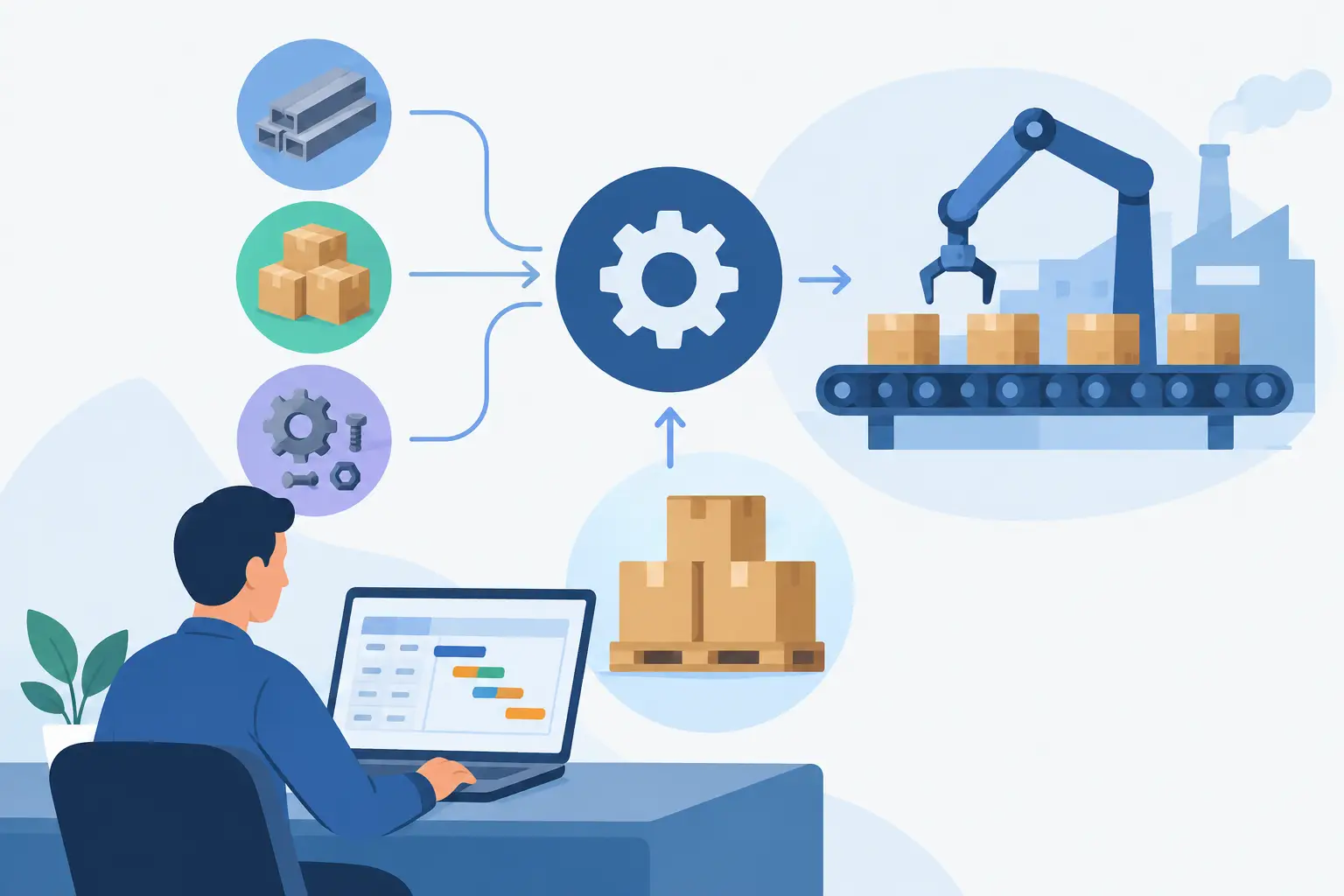
A production order can look straightforward until one missing component holds up the entire job. A factory may have the people, machine time and customer demand ready to go, yet still lose days because a fitting, chemical, label or packaging item was not ordered early enough. So, what is MRP? MRP stands for material requirements planning: a system and process that calculates what materials are needed, how many are required and when they must be available to meet a production schedule.
For manufacturers and process-based businesses, MRP replaces guesswork, spreadsheet chasing and last-minute purchasing with a connected plan. It turns demand into practical actions for procurement, warehouse teams and production planners.
What is MRP in manufacturing?
Material requirements planning works backwards from the products a business needs to make. It checks the production plan against the bill of materials, current inventory, open purchase orders and supplier lead times. From there, it recommends when to buy, transfer or produce each required item.
At its core, MRP answers three operational questions: what do we need, how much do we need, and when do we need it?
The answer is rarely as simple as the quantity on a sales order. A finished product may require multiple levels of components, sub-assemblies, packaging and consumables. A garment washing operation, for example, may need chemicals, garments, tags and cartons at different points in the workflow. A manufacturer may need to make a sub-assembly before final assembly can begin. MRP traces these dependencies so the right materials are available at the right stage.
MRP is particularly useful where stock is expensive, supply lead times vary, recipes or product structures are complex, and production delays have a direct commercial cost.
The data MRP uses to create a plan
MRP is only as dependable as the operational data behind it. It does not create demand or capacity by itself. It applies clear planning logic to the information the business provides.
Demand and the master production schedule
The starting point is demand. This may come from confirmed sales orders, forecasts, replenishment targets or planned production orders. The master production schedule sets out which finished goods are expected to be completed and by when.
A business making to order may rely more heavily on customer orders. A retailer or distributor with light manufacturing may use forecasts and minimum stock levels. Many businesses use both, balancing confirmed demand with a sensible buffer for expected sales.
Bills of materials and production recipes
A bill of materials, often called a BOM, defines the components needed to make a finished item. It can include raw materials, purchased parts, packaging and intermediate assemblies. In process manufacturing, the equivalent may be a formula or recipe with expected yields, batch sizes and by-products.
Accuracy matters here. If a BOM says one unit requires two metres of fabric when the actual requirement is 2.2 metres, the planning result will be wrong no matter how capable the software is. Version control is also essential when product designs, recipes or packaging specifications change.
Inventory, incoming supply and lead times
MRP considers on-hand stock, stock already allocated to other orders, material in quarantine, expected receipts and open purchase orders. It then compares available supply with demand over time.
Lead time tells the system how far ahead an order must be released. This should include supplier lead time, transport, receiving, quality checks and any internal preparation needed before the material can be used. For businesses importing components or managing seasonal supply, realistic lead times can make the difference between a workable plan and a costly shortage.
How an MRP calculation works
The calculation follows a logical sequence. First, MRP reads the planned output. It then explodes the BOM, meaning it breaks the finished item into every material and sub-assembly required. Next, it nets those requirements against stock on hand and scheduled receipts.
If there is a shortfall, the system proposes a planned order. That may be a purchase order for a raw material, a work order for an internally made part, or a stock transfer from another warehouse. Finally, it offsets the date by the relevant lead time so the order is released early enough.
Consider a simple example. A business plans to produce 500 units of a finished product next month. Each unit requires two components, so gross demand is 1,000 components. The warehouse has 300 usable units available and 200 more due from an existing supplier order. MRP identifies a net requirement of 500 components. If the supplier needs three weeks to deliver, the purchase order needs to be released at least three weeks before the material is required, not on the day production starts.
Real businesses add further detail: minimum order quantities, supplier pack sizes, safety stock, batch rules, scrap allowances and multiple warehouse locations. These rules help ensure recommendations are commercially practical, not merely mathematically correct.
What MRP does well, and where it has limits
A well-run MRP process improves material availability while reducing unnecessary inventory. Procurement teams receive clearer buying priorities. Warehouse teams can prepare for upcoming work. Production managers can identify shortages before they stop the line. Finance teams gain a more reliable view of commitments, stock value and working capital.
It also supports traceability. When production, inventory and purchasing work from the same data, it is easier to see which materials were planned for a job, what was consumed, what remains and where exceptions occurred. This is valuable in industries that manage batch tracking, quality checks, compliance records or customer-specific specifications.
However, MRP is not a substitute for sound operational discipline. It can calculate material requirements, but it cannot fix inaccurate stock counts, outdated BOMs, poor supplier performance or unrealistic production dates. Frequent changes to demand will also create frequent planning changes. That is not necessarily a software failure – it may be a useful signal that sales, purchasing and production need a clearer decision-making rhythm.
MRP also focuses primarily on materials. It does not, on its own, confirm whether a production line, machine, operator or subcontractor has enough capacity to complete the work. Capacity planning, finite scheduling and machine data can complement MRP by showing whether the plan is achievable on the shop floor.
MRP, ERP and MRP II: what is the difference?
MRP is commonly delivered as part of an ERP system. While MRP plans materials, enterprise resource planning connects that plan to purchasing, inventory, production, sales, finance and reporting. This matters because material decisions affect cash flow, customer commitments, margins and warehouse operations.
For example, a production planner may see a material shortage through MRP. In a connected ERP, they can also check the supplier order status, available stock across locations, related customer orders and the financial impact of expediting supply. Teams do not need to reconcile separate spreadsheets and standalone systems before acting.
You may also hear the term MRP II, or manufacturing resource planning. MRP II expands the original material focus to include production resources such as labour, machines and capacity. In practice, modern manufacturing ERP platforms often combine MRP, scheduling, shop-floor reporting, quality processes and financial controls in one environment.
For operationally complex businesses, the value increases when planning data connects to the source of activity. Machine and PLC integration can provide production status or output data. Mobile warehouse processes can improve stock accuracy. Power BI reporting can show shortages, supplier performance, inventory movement and plan-versus-actual results in a form managers can use quickly.
When does a business need MRP?
MRP becomes valuable when material decisions are no longer manageable through visual checks and individual knowledge. Common signs include frequent stock-outs, excess stock sitting unused, urgent freight costs, late production orders, unreliable delivery dates or planners spending hours reconciling spreadsheets.
It is not only for large manufacturers. A growing business with a modest product range can benefit if it has multi-level BOMs, variable lead times or several warehouses. Equally, a business with very simple production and readily available materials may not need a highly detailed planning setup. The right level of MRP depends on the complexity, volatility and cost of the operation.
Implementation should start with the fundamentals: clean item records, accurate units of measure, current BOMs, trustworthy stock balances and agreed lead times. It is usually better to begin with the products and materials that create the most risk, then expand the planning model as confidence grows.
OneBusiness brings MRP into a broader cloud ERP environment, so material planning can sit alongside inventory control, purchasing, production, accounting, analytics and industry-specific workflows. The objective is practical control: a plan that reflects what is happening across the business, not a report that is already out of date.
The best MRP outcome is not simply fewer purchase orders or more stock on hand. It is a calmer operation where teams can see upcoming requirements early, make informed trade-offs and keep production moving with confidence.