

A missed timesheet can become far more than an admin delay. For a labour-hire business, it can hold up payroll, create a client invoice dispute, obscure job profitability and leave consultants chasing information across calls, texts and spreadsheets. Labour hire software Australia businesses choose should bring these moving parts into one controlled workflow – without making day-to-day work harder for coordinators, workers or finance teams.
The right platform does more than store candidate records. It connects people, placements, awards, hours, rates, approvals, billing and financial reporting so managers can see what is happening across the business while there is still time to act.
Why labour-hire operations outgrow disconnected tools
Labour hire is operationally demanding because the same placement can affect several teams at once. In Labour hire software Australia, Operations needs to confirm the worker, role, site, shift and required competencies. The worker needs a simple way to receive the assignment and submit hours. Payroll needs accurate approved data, including the correct pay conditions. Finance needs invoices that reflect the client agreement. Management needs to know whether the job is profitable.
In Labour hire software Australia,When each step lives in a separate system, the business relies on rekeying and reconciliation. A coordinator may schedule work in one application, track timesheets in another, calculate pay in payroll software and prepare invoices from a spreadsheet. That process can work at a small scale, but it becomes fragile as placements, clients and work sites grow.
In Labour hire software Australia,The cost is not limited to administration. Disconnected data makes it harder to identify unfilled shifts, overdue approvals, margin leakage, expiring licences or a client whose bill rate no longer covers the actual cost of supply. It also makes month-end reporting a retrospective exercise rather than a management tool.
What effective labour hire software in Australia should connect
A useful labour hire platform should reflect the real sequence of work, from candidate onboarding through to payroll preparation, invoicing and performance reporting. The aim is not to force every operation into a rigid template. It is to create dependable controls around the workflows that matter most.
Placement, scheduling and worker availability
Coordinators need a current view of available workers, qualifications, site requirements and upcoming demand. A system should make it easy to match people to roles while recording the agreed client rate, worker pay rate, assignment dates and conditions. For high-volume businesses, this visibility can reduce last-minute calls and prevent unsuitable placements.
Mobile access matters here. Workers may be travelling between sites, working night shifts or unable to sit at a desktop. They should be able to view assignments, confirm details and submit required information from a mobile device. The interface must be straightforward, because a feature that workers do not use simply moves the process back to phone calls and paper forms.
Timesheets and approval controls
Timesheet accuracy is the centre of a profitable labour-hire operation. In Labour hire software Australia, software should capture hours against the right worker, client, job and cost centre, then route the timesheet to the appropriate approver. Clear status tracking helps the team distinguish submitted, queried, approved and payroll-ready hours.
The right approval design depends on the client. Some clients need supervisor approval for every shift. Others may accept weekly approvals or nominated approvers by site. A configurable workflow is more useful than a one-size-fits-all process, particularly when supplying labour into construction, warehousing, hospitality, manufacturing or industrial environments.
Businesses should also consider how the system handles exceptions. Missed breaks, changed shift times, allowances, overtime and cancelled shifts need an auditable process. The goal is not to eliminate judgement. It is to make changes visible, authorised and traceable.
Pay, billing and margin visibility
A placement is only commercially clear when pay and charge data are connected. Labour hire software should retain the agreed worker cost and client bill rate, apply relevant rules where configured, and pass approved information into payroll and invoicing processes without repeated data entry.
This connection gives managers a practical view of gross margin by client, job, branch, consultant or worker category. A healthy top-line sales figure can mask poor margins caused by incorrect rates, unbilled allowances, overtime, travel costs or an outdated client agreement. Real-time reporting allows management to investigate these issues before they become a quarterly surprise.
Labour hire software Australia is not a substitute for payroll, industrial relations or tax advice. Australian businesses should confirm that their chosen configuration supports their applicable awards, enterprise agreements, client contracts and internal approval policies. The platform should provide controls and reliable data; the business still owns its compliance decisions.
Financial and operational reporting
In Labour hire software Australia, Labour-hire data becomes much more valuable when it sits alongside finance. Rather than exporting spreadsheets each week, leaders can review revenue, costs, debtor exposure, outstanding timesheets, utilisation and margin from a shared data set.
Power BI reporting can add a clearer management layer for organisations that need to compare branches, clients, job types or periods. It can also help operations and finance work from the same definitions. If one report treats a placement as filled while another counts it only after timesheet approval, leadership is not seeing one version of performance.
How to assess labour hire software Australia providers
The best choice depends on the complexity of the operation. A small agency with straightforward placements may prioritise fast onboarding and clean invoicing. A business supplying workers across multiple sites, awards, states or client billing models will need deeper configuration, approval rules and reporting.
Start by mapping the actual process, including where staff currently re-enter data or chase approvals. Then assess each option against four practical questions:
- Can it manage worker records, credentials, placements, shifts and timesheets in a single workflow?
- Can pay rates, bill rates, allowances, cost centres and client-specific rules be configured and audited?
- Does it connect to financial accounting, invoicing, payroll processes and meaningful management reporting?
- Can the provider configure the platform around your operation and support the team after go-live?
It is worth asking for a demonstration using a real scenario rather than a generic product tour. For example, ask the provider to show a worker assigned to a client site, a changed shift, a timesheet query, approval, billing and the resulting margin report. This exposes whether the system works as an end-to-end operating platform or merely handles isolated tasks.
Security and data ownership should also be part of the decision. Labour-hire businesses hold sensitive worker information and commercially sensitive rate data. Clarify access permissions, audit trails, backup arrangements, cybersecurity support and how data can be exported if business requirements change.
Implementation succeeds when the workflow is owned
Software projects often stall because configuration is treated as an IT exercise. In Labour hire software Australia, the strongest implementation team includes operations, finance, payroll and the people who schedule workers every day. Each group sees different risks, from client approval delays to invoicing exceptions and inaccurate cost allocation.
A phased rollout is often sensible. Labour hire software Australia begin with core worker records, client records, placements, timesheets and approvals. Once the data is reliable, extend the rollout to advanced dashboards, automated billing, document controls and integrations. This approach avoids attempting to redesign every process at once while still delivering early operational value.
Data preparation deserves attention before go-live. Duplicate worker records, inconsistent client names and unstructured rate tables will carry old problems into a new platform. Establish clear ownership for master data and agree on the fields, status definitions and approval rules that the business will use going forward.
Training should be role-based. A consultant needs to know how to fill a shift and manage an exception. A client approver needs a quick, simple approval path. Finance needs confidence in the handover from approved hours to invoice and financial reporting. Giving every user the same generic training creates confusion rather than adoption.
A connected platform creates room to grow
For growing labour-hire businesses, the real benefit is not simply processing more timesheets. It is having the confidence to take on more clients, sites and workers without multiplying administrative effort or losing control of margin.
OneBusiness Labour hire software can bring labour hire administration together with accounting, billing, project workflows and Power BI analytics in one cloud ERP environment, with configuration around the way an organisation actually operates. That is particularly relevant for businesses that also manage warehousing, manufacturing, project work or other operational divisions.
The most valuable system is the one that makes the next decision clearer: who is available, what needs approval, which client is profitable and where action is required. When those answers are available in the daily workflow, labour hire teams can spend less time reconciling the past and more time running a dependable, scalable operation.
Connecting Organizations with the Right Workforce
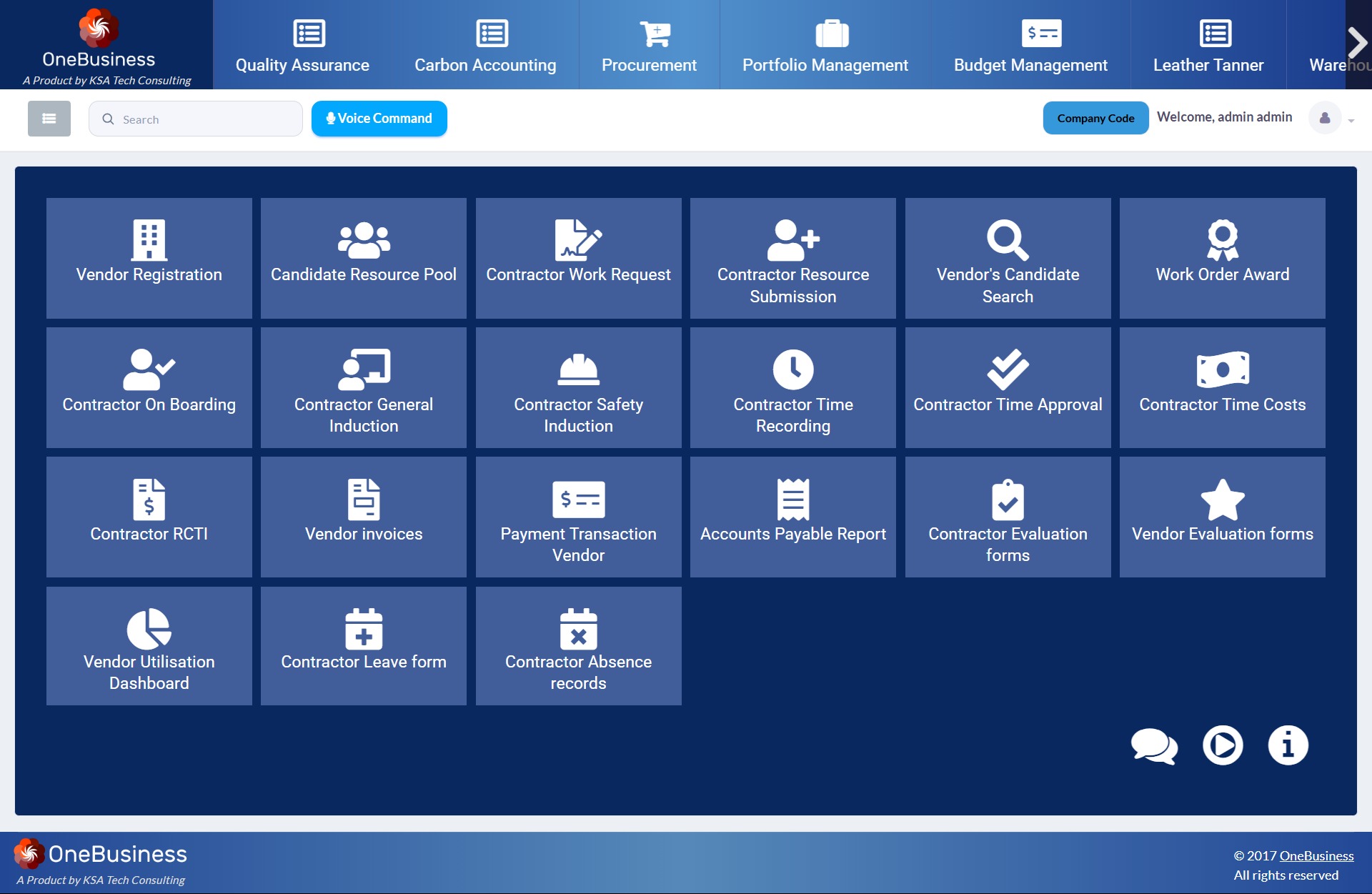
The Labour Hire Module in OneBusiness ERP provides an integrated platform that enables organizations to hire and manage contract workers through a streamlined digital process. The Labour Hire process begins with vendor registration, where labour hire vendors register their workers through an online labour hire portal by providing details such as resumes, roles, skills, qualifications, and experience. Company officials can then create Contractor Work Requests within the ERP, specifying the required role, skills, experience, duration, location, and other requirements. These requests are published to the labour hire portal, allowing registered vendors to submit suitable candidates directly against the specific requirement.
The Labour Hire Software also incorporates AI-powered candidate matching to simplify the recruitment process. Through the Vendor Candidate Search functionality in Labour hire software Australia, the system analyzes the work request against the available candidates in the resource pool and ranks them based on relevant factors such as skills, experience, qualifications, and role suitability. This allows organizations to quickly identify the most appropriate candidates and make informed hiring decisions. Selected candidates can be approved directly from the ERP, with communication initiated through the system, followed by Work Order Award and Contractor Onboarding. The onboarding process in Labour hire software Australia, can include general induction and safety induction before the contractor begins work.
Once the contractor is onboarded, the complete workforce lifecycle can be managed within the ERP. Contractor Time Recording captures the hours worked, which are used to calculate contractor costs based on the agreed rate and actual working hours. The system can then generate RCTI and vendor invoice-related transactions, process vendor payments, maintain the relevant accounting entries, and automatically update the Accounts Payable records and reports. Beyond workforce administration, the module provides additional tools such as Contractor Evaluation, Vendor Evaluation, Vendor Utilisation Dashboard, Leave Management, and Absence Records, giving organizations greater visibility into contractor performance, vendor effectiveness, workforce utilization, and ongoing workforce management.