
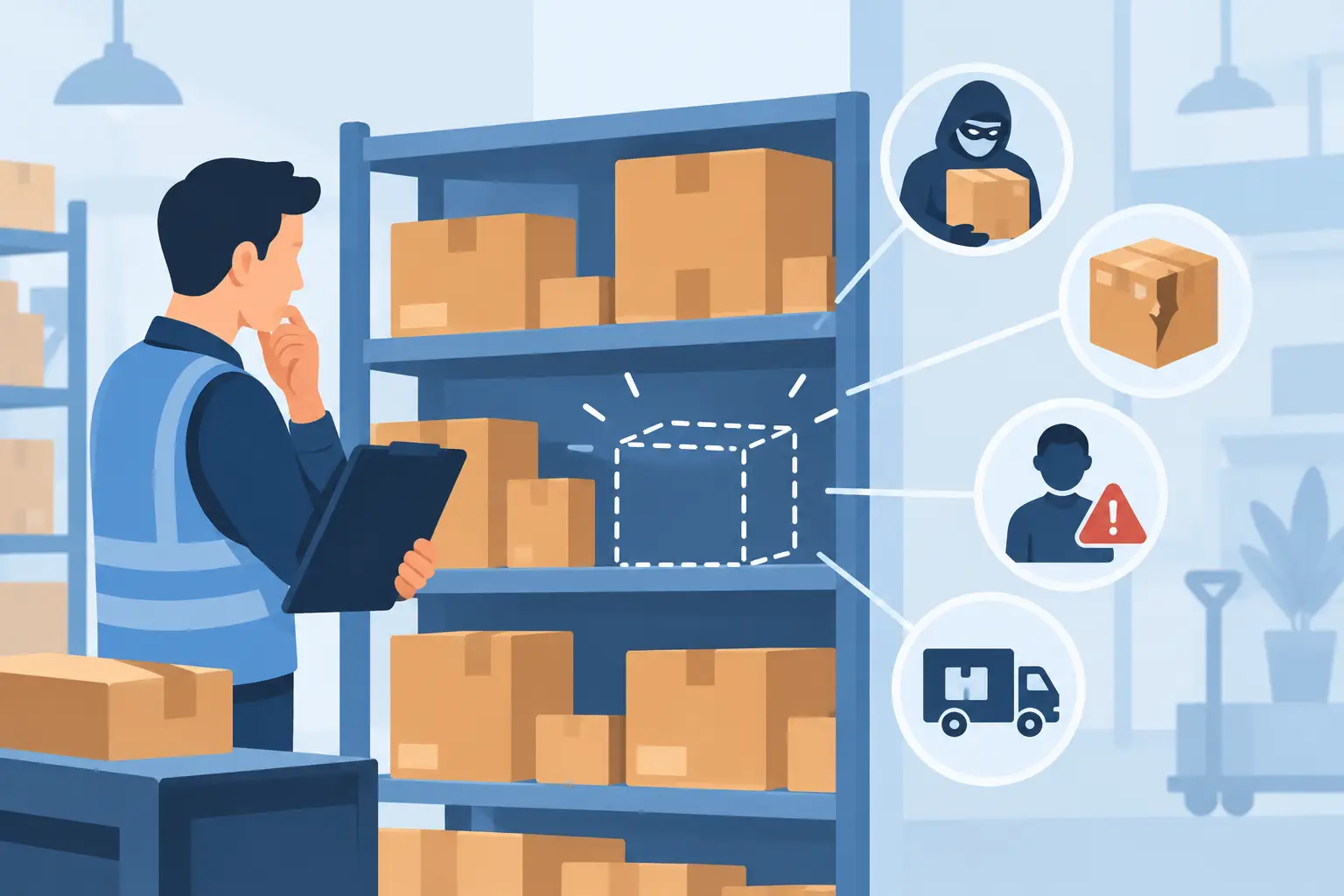
A stocktake that shows fewer units than your system records is not simply an inventory problem. It is a margin problem, a planning problem and, in some cases, a control problem. Understanding what causes inventory shrinkage helps operational leaders move beyond writing off variances and start fixing the process, location or transaction behind them.
Inventory shrinkage is the gap between the quantity or value of stock recorded in your system and what is physically available. It can appear in a retail storeroom, a manufacturing parts cage, a warehouse, a plantation input shed or a hospitality venue. The reason is rarely one dramatic event. More often, small errors and weak hand-offs accumulate across receiving, storage, production, sales and stock adjustments.
What causes inventory shrinkage across operations?
The main causes are theft, administrative mistakes, supplier discrepancies, damaged or expired goods, production loss and poor inventory processes. Each can produce similar-looking variances in a stocktake, but the required response is different. A missing carton caused by an unrecorded transfer should not be investigated in the same way as repeated high-value losses from a restricted warehouse zone.
Receiving and data-entry errors
Inventory accuracy starts at goods receipting. If a team member receives 96 units but enters 100, the system creates stock that never existed. If stock is received under the wrong item code, warehouse location or unit of measure, it may be physically present but effectively invisible to the people trying to pick, sell or consume it.
Unit-of-measure errors are particularly costly in manufacturing and process industries. Recording a pallet as individual units, kilograms as bags, or a bulk ingredient as a finished product can distort both quantity and inventory valuation. The issue may remain hidden until a production order fails or a stocktake uncovers a large discrepancy.
Supplier short deliveries can produce the same result. A purchase order may show 50 cases, while 48 arrive. When staff receipt against the order without counting or checking delivery documentation, the discrepancy becomes internal inventory shrinkage even though it originated upstream.
Theft and unauthorised stock removal
Theft can involve employees, visitors, contractors, delivery drivers or customers. It is often associated with retail, but warehouses and production sites are also exposed, especially where small, high-value or easily resold items are accessible.
Not every unauthorised removal is deliberate theft. Materials may be borrowed between sites, used for an urgent job, given away as samples or taken for testing without being issued in the system. From a control perspective, the result is the same: stock leaves without a traceable transaction.
The risk rises where access is broad, movements are not scanned, returns are loosely managed or stock adjustments can be entered without approval. Restrictive controls alone are not always the answer. A busy operation needs people to complete transactions quickly. The practical goal is to make the correct process easier than the workaround.
Picking, transfer and dispatch mistakes
Stock may be correctly received but lost in movement. A picker can select the wrong item, a transfer can be physically completed but not posted, or a despatch team can send an extra carton without updating the sales order. In multi-warehouse businesses, inventory may be recorded at one site while sitting at another.
These mistakes are common when teams rely on paper pick slips, informal messages and spreadsheet updates. They are also more likely during peak periods, shift changes and urgent customer orders, when staff are trying to keep goods moving.
Barcode scanning, location-controlled picking and mobile warehouse transactions reduce this exposure because each movement creates a time-stamped record. The technology is useful, but process discipline still matters. Scanning only works if item labels, locations and master data are accurate.
Damage, spoilage and expiry
Some shrinkage is physical and unavoidable to a degree. Food can spoil, chemicals can degrade, materials can be contaminated, garments can be damaged and fragile goods can break. The business still needs to record the loss promptly and accurately rather than leave unusable stock on hand.
Unrecorded damage creates a false picture of available inventory. Purchasing may delay replenishment because the system says there is enough stock, while production or sales teams discover too late that the material cannot be used.
For perishable, regulated or batch-controlled stock, expiry dates and quality status should be part of normal inventory control. Quarantine locations, reason-coded write-offs and lot traceability provide a clearer view of what can be sold, consumed, reworked or disposed of.
Production waste, yield variance and rework
Manufacturers often find that shrinkage is not missing stock at all. It is an inaccurate understanding of what production consumes and produces. A bill of materials may assume a standard yield that no longer reflects actual machine performance, raw-material quality, moisture content, cutting patterns or operator practices.
For example, a process may consume more raw material than the standard allows, produce lower output than planned or generate scrap that is not reported. If production teams record only finished goods and do not capture actual consumption, scrap, rejects and rework, the variance lands in inventory at month end.
Machine and PLC data can help identify where expected and actual output diverge. That matters in industrial operations because a variance by product line, batch or machine is far more actionable than a single stock adjustment at the end of the period. It can point to calibration issues, maintenance needs, quality failures or an outdated production standard.
Pricing, returns and point-of-sale gaps
In retail and hospitality, shrinkage can arise when sales, refunds, voids, discounts and returns are not consistently controlled. A product may leave the premises without a completed sale, or a refund may be processed without the item returning to stock. Incorrect product mapping can also reduce inventory without correctly recognising revenue or cost.
This does not mean every exception signals misconduct. Legitimate service recovery, wastage and customer returns are part of many businesses. The concern is whether these events are documented with clear reasons, appropriate approvals and a link to the underlying stock movement.
Weak master data and disconnected systems
Duplicate item records, outdated product descriptions, incorrect conversion factors and inactive locations make inventory harder to control. So do disconnected systems where accounting, purchasing, warehouse management, point of sale and production each maintain their own version of stock.
Manual rekeying creates delay and error. A sale may be invoiced but not deducted from inventory until later. Production might consume materials in a spreadsheet while finance posts the cost at month end. Teams then spend time debating which number is correct rather than addressing the operational cause.
A connected ERP platform gives each department a common transaction trail, from purchase order and goods receipt through to production issue, sale, return and adjustment. This does not eliminate shrinkage by itself, but it makes exceptions visible earlier and makes root-cause analysis more reliable.
How to identify the real cause of inventory shrinkage
A full annual stocktake is necessary for many businesses, but it is too slow to be the only control. Cycle counting is more effective for finding issues while the evidence is still available. Count high-value, fast-moving, sensitive or frequently adjusted items more often than stable, low-risk inventory.
When a variance appears, investigate it by item, location, shift, supplier, customer order, production batch and transaction type. A pattern tells a better story than a total value. Repeated differences at one receiving bay may indicate counting errors. Losses concentrated around a specific item or shift may require an access review. Variances linked to a production batch may point to yield or quality issues.
Reason codes are essential. “Stock adjustment” is not a useful explanation. Categories such as damaged in handling, expired, supplier short delivery, picking error, production scrap, customer return or count correction create data that managers can analyse. Keep the list practical enough that staff will use it correctly.
It also helps to separate operational tolerances from unexplained losses. Some sectors expect a level of evaporation, trimming waste or spoilage. Those allowances should be measured, approved and reviewed, not treated as a blank cheque for poor process control.
Controls that reduce shrinkage without slowing work
The most effective controls fit into daily workflows. Start with accurate item master data, defined storage locations and clear ownership for receiving, transfers, stock adjustments and write-offs. Use scanning where volume and risk justify it, and require approval for adjustments above set quantity or value thresholds.
Segregating duties is useful, particularly for valuable inventory. The person who receives goods should not be the only person able to approve supplier discrepancies or write stock off. In a smaller business, full separation may not be practical, so owner or manager review of exception reports can provide a sensible alternative.
Operational reporting should focus on action. Track inventory accuracy, adjustment value, write-offs, stock ageing, supplier shortages, negative inventory, production yield and counts overdue. Power BI dashboards can show trends by site, product group or period, while alerts can flag unusual adjustments before they become a month-end surprise.
OneBusiness can bring inventory, purchasing, production, sales, accounting and operational reporting into one connected environment, giving teams a clearer trail from physical stock movement to financial impact. The right configuration matters: a retailer, tannery and labour-hire business will not need the same controls or workflows.
The most useful next step is to choose one high-risk stock category, trace its journey from receipt to sale or consumption, and compare every expected system transaction with what people actually do on the floor. That exercise often reveals the small gaps where inventory shrinkage begins – and the practical changes that restore control.