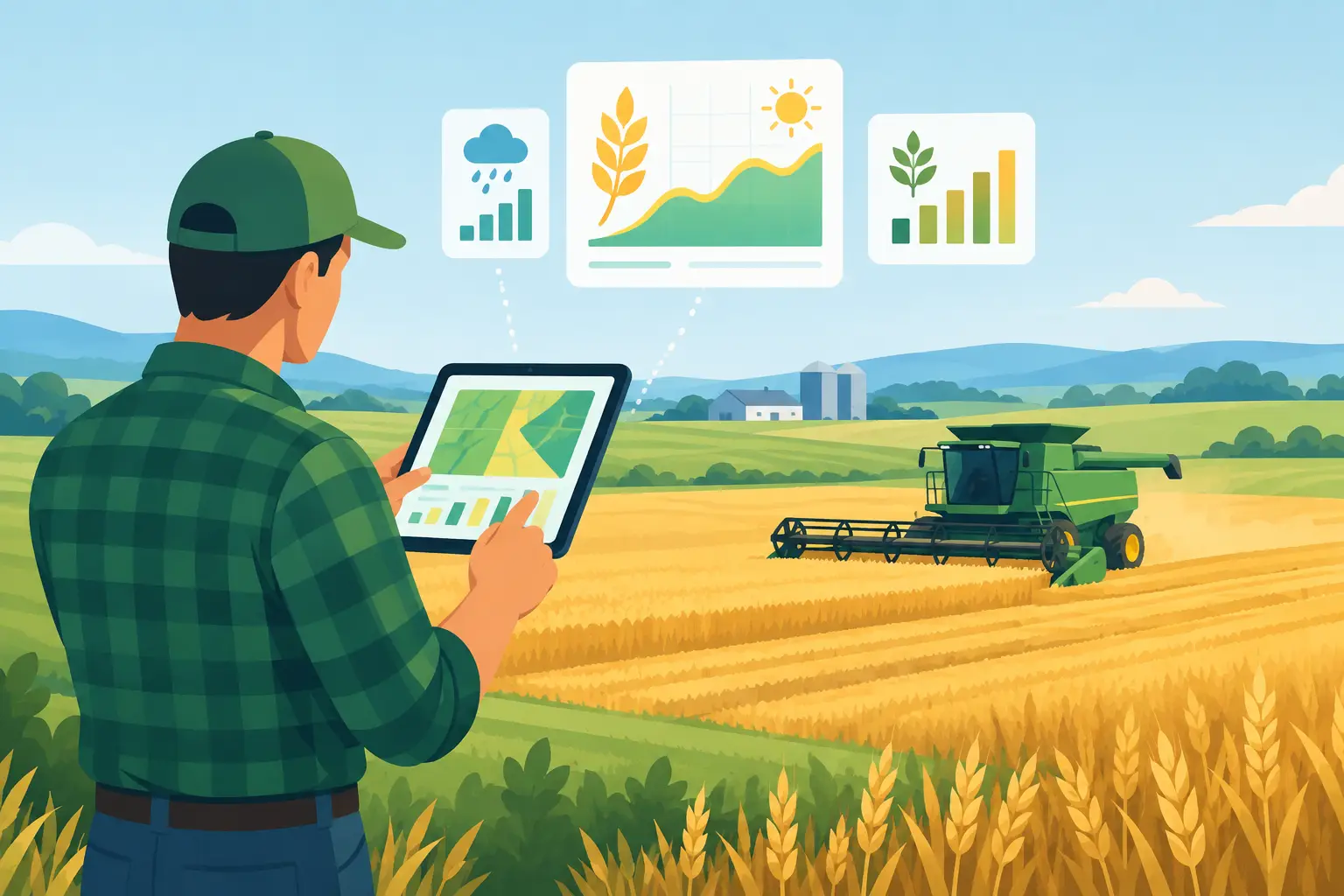
A harvest estimate that arrives after labour is booked, transport is scheduled and customers have been promised stock is not much of a forecast. For plantation and processing businesses, the best harvest forecasting tools turn field observations, weather patterns, crop activity and operational records into a practical view of what is likely to arrive, when it will arrive and what it may be worth.
The right choice is not always the platform with the most imagery, sensors or artificial intelligence features. It is the one that gives growers, operations managers and finance teams information they can act on – from organising harvest crews to planning packhouse capacity, inventory, cash flow and sales commitments.
What a useful harvest forecast needs to answer
A useful forecast goes beyond a single yield number. It should distinguish between expected volume, harvest timing, quality or grade, and confidence level. A manager needs to know whether 400 tonnes are expected across a two-week window, for example, or whether the estimate is likely to vary by 20 per cent because weather, pest pressure or fruit set data is incomplete.
This distinction matters in Australian operations where seasonal labour, regional freight capacity and processing windows can quickly become constraints. A forecast that is accurate enough for agronomy but disconnected from production, warehouse and financial planning still leaves teams building manual workarounds in spreadsheets.
The strongest systems combine several data sources: historical yields, block or field records, planting dates, crop growth stages, weather, satellite imagery, machine data, manual scouting and harvest receipts. Not every business needs every source. The best starting point is the decision that needs improving.
7 best harvest forecasting tools and capabilities
1. Farm management platforms with block-level records
Farm management platforms are often the practical foundation for harvest forecasting. They store field or block details, varieties, planting dates, spray records, irrigation events, crop observations and prior harvest results. That history makes it easier to compare like-for-like blocks rather than relying on a farm-wide average.
This approach works particularly well for growers who need disciplined operational records before adding advanced analytics. Its limitation is that forecast quality depends on consistent field entry. If supervisors record activities late, use different block names or do not capture actual harvest weights, the system will reproduce that inconsistency at speed.
2. Satellite imagery and remote sensing platforms
Remote sensing tools use satellite imagery to monitor vegetation condition across broad areas. They can highlight uneven growth, water stress and crop variability, helping managers focus scouting and estimate which blocks are progressing ahead of or behind plan.
For large plantations, this can be far more efficient than inspecting every block manually. However, vegetation indices are indicators, not a final yield forecast. Cloud cover, canopy density, crop type and the relationship between plant vigour and marketable yield all affect usefulness. Treat imagery as an early-warning layer that should be checked against field observations and actual harvest data.
3. Weather and crop-modelling tools
Weather-based models use temperature, rainfall, evapotranspiration and growing degree days to estimate crop development and likely harvest timing. They are especially valuable when timing matters as much as volume, such as fruit ripening, vineyard operations or crops entering a processing facility.
Their main advantage is forward visibility. If heat accumulation suggests a harvest will start earlier than planned, teams can adjust labour, packaging and transport before the rush begins. The trade-off is that models need local calibration. A generic model may not reflect a particular variety, soil profile, irrigation practice or microclimate.
4. In-field sensors and connected irrigation data
Soil moisture probes, weather stations, flow meters and other connected devices provide a more immediate view of growing conditions. When their data is linked with crop stage and historical outcomes, they can strengthen both yield and timing forecasts while supporting irrigation decisions.
Sensors are most valuable where the team has a clear response process. Installing devices without assigning someone to review exceptions, verify readings and act on them creates more data rather than better control. Businesses should also account for connectivity, maintenance and sensor placement across remote sites.
5. Machine vision, drone and crop-counting systems
Machine vision can estimate fruit, bunch, pod or plant counts using cameras mounted on equipment, handheld devices or drones. In suitable crops, it can produce detailed estimates of crop load and variability before harvest begins. This is a powerful option for high-value horticulture where sample counts are labour-intensive and grade distribution affects commercial outcomes.
It is not a universal answer. Visual counts can be affected by foliage, lighting, fruit occlusion and changing crop appearance. The model also needs local training data and periodic validation against weighbridge or packhouse results. Businesses should ask suppliers how their accuracy is measured in conditions similar to their own operation.
6. AI forecasting and analytics platforms
AI and machine learning tools can combine historical production, weather, remote sensing, scouting and operational inputs to identify patterns that are difficult to see in separate reports. They can also improve over time as more actual harvest results are captured.
The value lies in forecasting ranges and explaining the drivers behind them, not simply presenting a precise-looking number. A good system should show whether an estimate is based on strong data, identify the blocks driving variation and allow managers to override a forecast with documented field knowledge. Black-box predictions are difficult to trust when sales, labour and cash flow decisions are on the line.
7. Connected ERP and harvest planning systems
For operationally complex growers, a connected ERP system is the tool that turns a crop forecast into an executable plan. It links expected harvest volumes with labour requirements, packing materials, production schedules, cold storage, customer orders, invoices, inventory and financial projections.
This is where forecasting produces commercial control. A forecast of an earlier harvest can trigger a review of available crews, packaging stock and packhouse capacity. A lower expected grade can flow into sales planning and margin forecasts rather than being discovered after product reaches the warehouse. A connected platform such as OneBusiness can bring these workflows together, with configurable plantation, inventory, production and Power BI reporting processes in one place.
How to choose between harvest forecasting tools
Start with the operational decision that currently creates the most cost or uncertainty. If the immediate problem is knowing which blocks need inspection, imagery and scouting tools may deliver the fastest improvement. If harvest dates regularly disrupt workforce planning, weather and phenology modelling may be the priority. If the business can estimate yield but struggles to coordinate picking, packing, stock and billing, ERP integration is likely to matter more than another standalone field app.
When assessing a platform, test it against a recent season rather than a perfect future scenario. Can it import historical harvest weights by block, variety and grade? Can it compare forecast volume with actual receipts? Can operations staff enter data easily on a mobile device? Can finance see the effect on revenue and working capital without manually exporting data? These questions reveal whether a tool will fit daily operations.
Integration should be assessed early. A forecast that remains isolated from inventory, production planning and customer commitments creates a new reporting task for someone else. Look for practical data flows between field records, machinery or PLC data where relevant, weighbridges, packhouse systems, warehouse records and financial accounts. Clear access controls, backups and managed cybersecurity also matter when production and commercial data are held in the cloud.
Measure forecast performance, not just software features
The first season should establish a baseline. Compare predicted and actual harvest volume by block, week and grade. Review timing accuracy separately from yield accuracy, because a forecast can be close on total tonnes yet still be unhelpful if it misses the peak harvest week.
Use those results to improve inputs and processes. Sometimes the solution is a better model; often it is clearer block master data, more consistent crop observations or faster recording of harvested weights. Teams should also agree on how forecasts are approved and when revisions are communicated to sales, production and finance.
A forecast does not need to eliminate uncertainty to be commercially valuable. It needs to make uncertainty visible early enough for the business to prepare. The right system gives your team a defensible range, a clear view of the assumptions behind it and enough connected operational data to make the next decision with confidence.