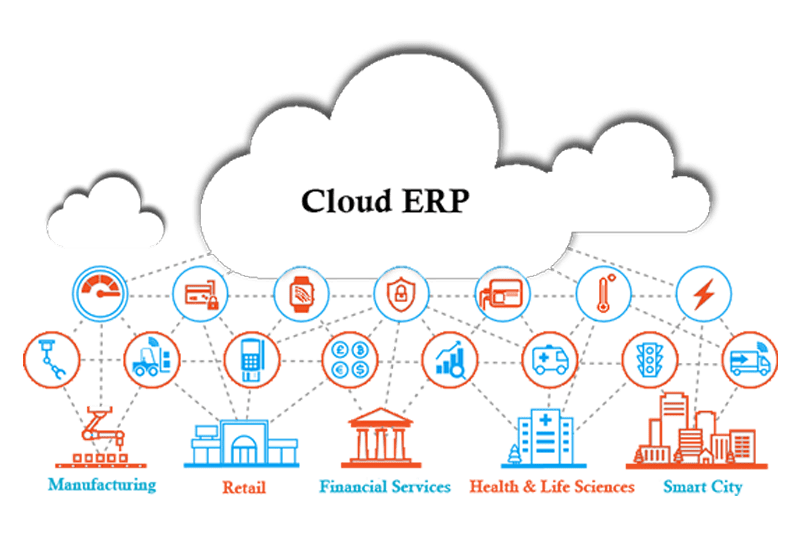
Cloud ERP advantages

Cloud ERP Advantages for Small Businesses: Why Growing Businesses Need a Modern ERP
Small businesses today operate in an increasingly digital and competitive environment. Customers expect faster service, employees need access to information wherever they work, and business owners need accurate financial and operational information to make decisions quickly.
Yet many growing businesses still manage their operations through a combination of spreadsheets, accounting applications, emails, disconnected CRM systems, and manual processes.
This approach may work when a company is very small. As the business grows, however, disconnected systems can create duplicated data, manual reconciliation, limited visibility, process delays, and greater potential for human error.
This is where Cloud ERP (Enterprise Resource Planning) can make a significant difference.
A modern Cloud ERP platform brings key business processes—including Finance, Sales, CRM, Procurement, Inventory, Projects, HR and business analytics—into a connected digital environment.
Solutions such as OneBusiness ERP are designed around a simple principle:
One Platform. Complete Business Control.
Instead of treating ERP as technology reserved for large enterprises, OneBusiness ERP brings integrated business management, cloud accessibility, workflow automation, analytics and AI-ready capabilities to small and growing businesses.
What Is Cloud ERP?
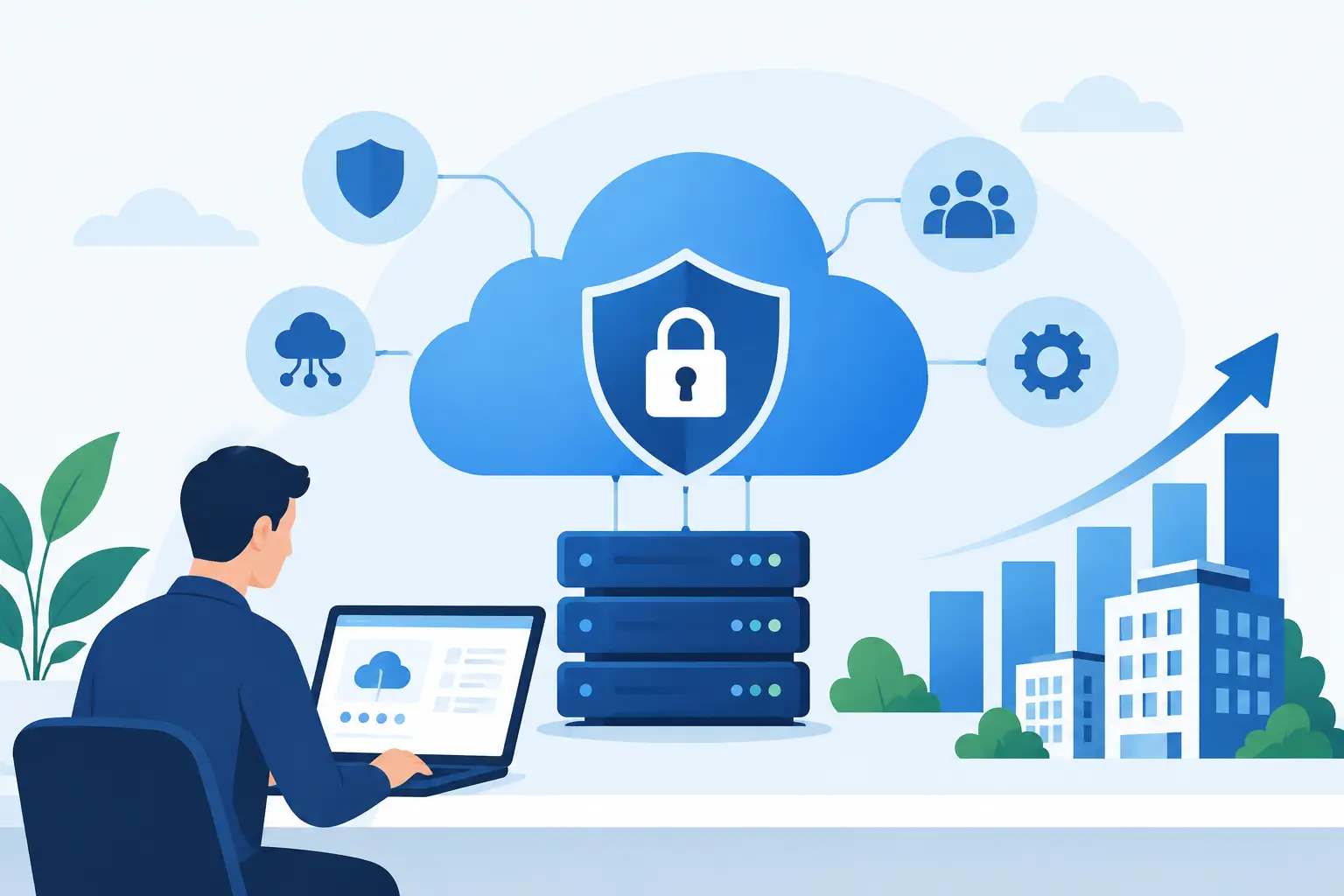
Cloud ERP is an Enterprise Resource Planning system delivered through cloud infrastructure rather than being installed and operated entirely on servers located within the business premises.
Users access the ERP securely through the internet, allowing authorised employees to work with business information from different locations and devices, subject to the organisation’s security policies and access controls.
More importantly, Cloud ERP creates a single connected business platform.
For example, a customer enquiry can become a sales opportunity, an opportunity can become a quotation, a quotation can become a sales order, the order can update inventory requirements, delivery can generate financial transactions, and management can monitor the entire process through reports and dashboards.
Instead of moving information manually between separate applications, data can flow through an integrated business process.
That integration is one of the most important advantages of Cloud ERP for small businesses
What Are the Main Cloud ERP Advantages for Small Businesses?
Before investing in any business technology, small business owners should understand how the technology will improve operations, reduce administrative effort and support future growth.
The following are some of the most important benefits of adopting Cloud ERP.
1. One Integrated Platform Instead of Multiple Disconnected Systems
Many small businesses gradually accumulate different applications as they grow.
They may use:
-
accounting software for finance;
-
spreadsheets for inventory;
-
another application for CRM;
-
email for approvals;
-
separate systems for HR;
-
manual reports for management; and
-
spreadsheets for forecasting and planning.
The problem is not necessarily that each application performs poorly. The problem is that business information becomes fragmented across multiple systems.
Cloud ERP provides an alternative by connecting major business functions within one platform.
With an integrated ERP such as OneBusiness ERP, Finance, Sales, CRM, Inventory, Procurement, Projects and other business functions can operate using connected information.
This helps create a single source of business information and reduces unnecessary duplication.
Business advantage
When a salesperson creates an order, inventory availability can be checked immediately. When goods are delivered, the transaction can flow into financial processes. Management can then analyse sales, stock and financial information without manually combining multiple spreadsheets.
The objective is not simply to digitise individual departments.
The objective is to connect the entire business process.
2. Access Business Information from Anywhere
One of the major advantages of Cloud ERP is accessibility.
Authorised users can access the ERP through the internet without being dependent on a particular office computer or local server environment.
This can be especially valuable for businesses with:
-
employees working remotely;
-
multiple offices;
-
warehouses;
-
sales representatives travelling to customers;
-
managers working across different locations; or
-
businesses operating across multiple regions.
For example, a sales manager can review opportunities and quotations while travelling, while a finance manager can monitor receivables and cash-flow information from another location.
Cloud accessibility therefore supports a more flexible and responsive workforce.
3. Real-Time Visibility for Better Business Decisions
Small businesses often make important decisions using information that has been manually compiled from multiple sources.
By the time the report is prepared, the underlying business situation may already have changed.
Cloud ERP helps organisations move towards real-time operational visibility.
Depending on the modules implemented, management can monitor information such as:
-
sales performance;
-
outstanding customer receivables;
-
cash position;
-
inventory availability;
-
purchasing requirements;
-
supplier commitments;
-
customer opportunities;
-
order status;
-
project performance; and
-
profitability.
Instead of asking:
“Can somebody prepare a spreadsheet showing our current position?”
management can increasingly use ERP dashboards and reports to answer business questions directly.
This improves the speed and quality of decision-making.
4. Improved Productivity Through Automation
A significant amount of time in small businesses can be consumed by repetitive administrative work.
Employees may manually:
-
enter the same information into multiple systems;
-
prepare reports;
-
reconcile spreadsheets;
-
search for documents;
-
follow up approvals;
-
check overdue invoices;
-
prepare quotations; or
-
communicate routine information between departments.
An integrated Cloud ERP can automate or streamline many of these processes.
For example:
Customer → Opportunity → Quotation → Sales Order → Delivery → Invoice → Payment
can become a connected business process rather than a series of disconnected manual activities.
The result is not simply faster data entry.
The real benefit is allowing employees to spend more time on activities that create value for customers and the business.
5. Lower Technology Infrastructure Requirements
Traditional ERP implementations historically required businesses to purchase and maintain substantial IT infrastructure.
This could include servers, storage, operating systems, databases, backup infrastructure and specialised IT resources.
Cloud ERP changes this model.
Because the application infrastructure is delivered through the cloud, businesses can reduce their dependence on maintaining large amounts of on-premises infrastructure.
Depending on the ERP deployment and subscription model, this can help reduce:
-
upfront infrastructure investment;
-
server maintenance;
-
hardware replacement;
-
infrastructure administration;
-
software deployment complexity; and
-
upgrade management.
For a growing business, this can make sophisticated business management technology more accessible.
It also allows the organisation to concentrate more of its resources on running and expanding the business rather than maintaining underlying infrastructure.
6. Stronger Security and Controlled Access to Business Data
Business information is one of an organisation’s most valuable assets.
Financial records, customer information, supplier information, pricing, employee data and commercial transactions all need appropriate protection.
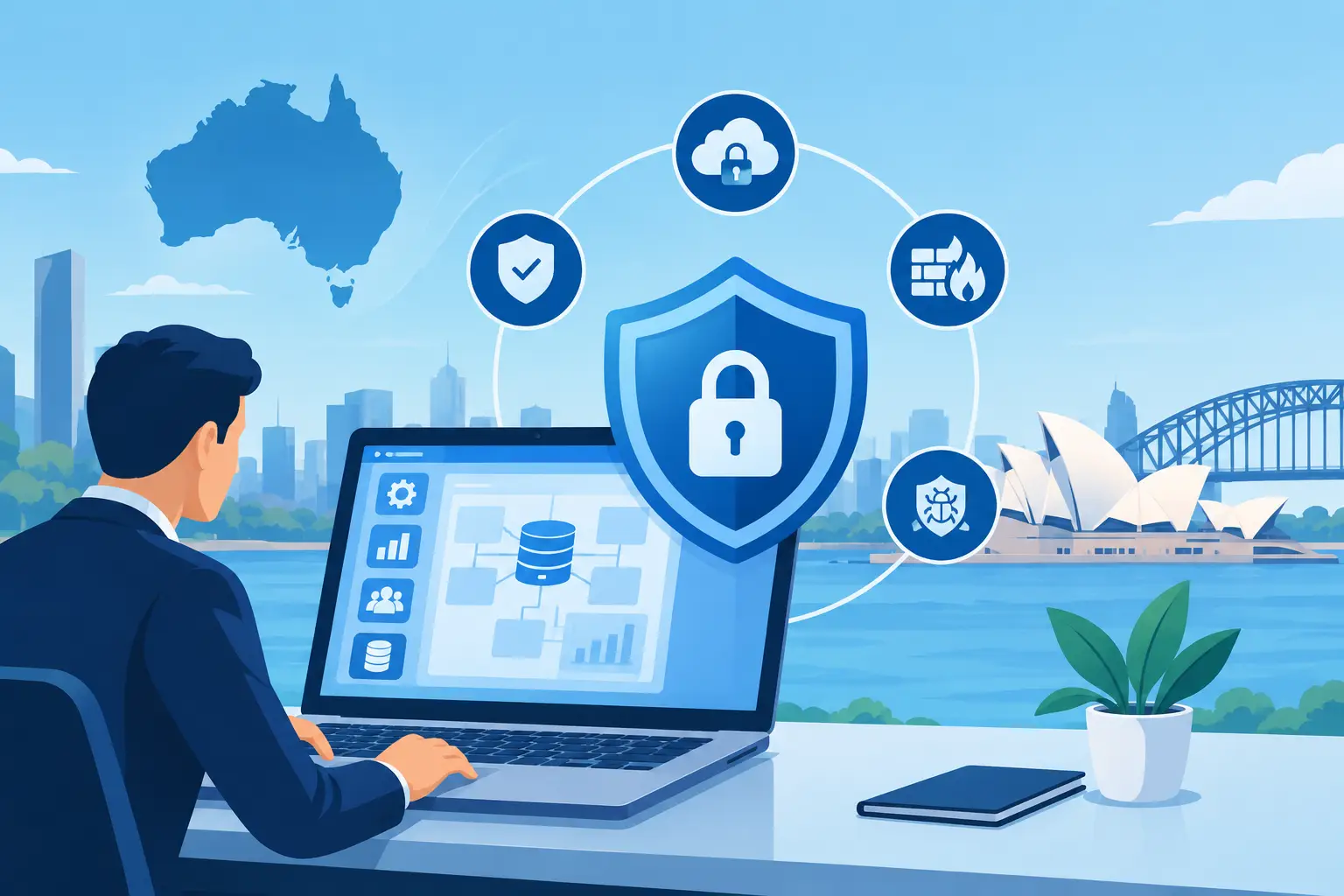
Modern Cloud ERP platforms can provide security capabilities such as:
-
role-based access control;
-
authentication;
-
permission management;
-
encrypted communications;
-
audit trails;
-
backup and recovery mechanisms; and
-
cloud infrastructure security controls.
An important principle is that employees should have access to the information required for their responsibilities without automatically having access to everything in the organisation.
For example, a salesperson may need access to customer and opportunity information while sensitive payroll or financial administration information remains restricted.
Cloud ERP therefore helps businesses establish more structured control over business information.
Security, however, remains a shared responsibility. Businesses should combine ERP security capabilities with strong identity management, appropriate permissions, secure devices, user education and sound cybersecurity practices.
7. Better Collaboration Between Departments
Disconnected systems often create disconnected departments.
Sales may maintain one set of customer information, Finance another, while Inventory and Procurement operate from separate spreadsheets.
This can result in questions such as:
“Which number is correct?”
With an integrated ERP platform, departments can work from connected business information.
For example:
Sales can see customer and opportunity information.
Inventory can understand product demand and availability.
Procurement can identify purchasing requirements.
Finance can monitor invoices, payments and receivables.
Management can analyse information across the organisation.
This creates a more collaborative operating model because departments are no longer working as isolated information silos.
8. Better Inventory Management
Inventory can represent a significant investment for product-based small businesses.
Too much inventory ties up working capital.
Too little inventory can result in stock-outs, delayed orders and dissatisfied customers.
Cloud ERP can provide greater visibility into:
-
stock on hand;
-
inventory movements;
-
warehouse balances;
-
sales demand;
-
purchasing;
-
historical consumption;
-
reorder requirements; and
-
slow-moving inventory.
With better information, businesses can make more informed purchasing and inventory decisions.
Advanced ERP environments can go further by using forecasting and analytics to help organisations anticipate future demand.
This transforms inventory management from simply recording transactions into supporting better operational planning.
9. Improved Cash-Flow and Accounts Receivable Management
Cash flow is particularly important for small and growing businesses.
A profitable business can still experience financial pressure when customers do not pay invoices on time.
An integrated Cloud ERP provides Finance teams with better visibility into information such as:
-
customer balances;
-
outstanding invoices;
-
invoice ageing;
-
overdue receivables;
-
payment history;
-
credit exposure; and
-
collection priorities.
Instead of discovering overdue accounts during month-end reporting, businesses can monitor receivables continuously.
This creates opportunities for earlier intervention and more systematic collection processes.
Modern ERP platforms can also combine financial information with analytics and AI to help identify accounts that may require attention.
10. AI-Powered ERP: Moving from Recording Transactions to Supporting Decisions
The next generation of ERP is not limited to recording business transactions.
ERP platforms contain valuable operational data about customers, products, invoices, inventory, sales, suppliers and business performance.
Artificial intelligence can help organisations use that information more effectively.
Within the OneBusiness ERP design philosophy, AI should not exist as an isolated technology experiment. It should work alongside real business processes and trusted ERP information.
Potential applications include:
Accounts Receivable Intelligence
AI can help analyse overdue customers, payment history, invoice ageing, customer risk and other relevant information to help Finance teams prioritise collection activities.
Intelligent Sales Quotations
Sales information, customer history, opportunity data, previous quotations, discounts and margins can be analysed to provide better decision support when preparing quotations.
Inventory Forecasting
Historical inventory movements and demand patterns can support forecasting and purchasing decisions.
CRM Intelligence
Customer interactions, opportunities and sales history can help sales teams identify priorities and recommended follow-up activities.
Management Insights
AI can help users interact with complex ERP information through more natural questions and business-oriented explanations.
For example, instead of simply viewing an accounts receivable report, a manager could potentially ask:
“Which overdue customers should we prioritise today, and why?”
The ERP provides the trusted business data. AI helps interpret that information and turn it into actionable insight.
This represents an important evolution:
Traditional ERP records what happened.
Modern ERP helps explain what is happening.
AI-powered ERP can help businesses decide what to do next.
11. Cloud ERP Can Scale with a Growing Business
Small businesses should not select technology based only on their current requirements.
They should also consider what happens when the business grows.
A company may begin with one location and a small number of employees. Over time it may add:
-
more users;
-
additional warehouses;
-
new product lines;
-
additional business entities;
-
larger transaction volumes;
-
new departments; or
-
operations in additional locations.
Replacing core business systems every few years can be disruptive and expensive.
A scalable Cloud ERP platform allows businesses to expand their digital operating model as the organisation grows.
This is one reason ERP should be viewed as more than an accounting system.
It becomes part of the company’s long-term digital foundation.
12. Standardised Business Processes
Growth often exposes weaknesses in informal business processes.
When a company has five employees, people may know instinctively who needs to approve a purchase or how a customer complaint should be handled.
At fifty or one hundred employees, informal processes become much harder to manage.
ERP helps businesses establish consistent processes for activities such as:
Lead → Opportunity → Quote → Order
Purchase Request → Approval → Purchase Order → Receipt
Delivery → Invoice → Payment
Customer Issue → CRM Follow-up → Resolution
Standardisation makes processes easier to understand, monitor, audit and improve.
This is particularly valuable for businesses preparing for significant growth.
13. Better Customer Service
Customers do not care whether Sales, Finance, Inventory and Logistics use different internal systems.
They expect the business to provide an accurate answer.
When information is fragmented, customer-facing employees may need to contact several departments before responding to basic questions.
An integrated Cloud ERP can provide authorised users with a more complete view of the customer relationship, including relevant information about orders, quotations, deliveries, invoices and interactions.
This helps businesses respond to customers more quickly and consistently.
Better information can therefore translate directly into a better customer experience.
Why Is Cloud ERP Particularly Important for Small Businesses?
Large organisations can sometimes compensate for inefficient systems by employing additional administrative resources.
Small businesses rarely have that luxury.
Every hour spent manually reconciling spreadsheets, searching for information or entering the same data multiple times represents time that could have been spent selling, serving customers, improving products or growing the business.
For this reason, ERP can be particularly valuable for smaller organisations.
The purpose is not to make a small business operate like a large corporation.
The purpose is to give a growing business better control without unnecessary complexity.
Cloud ERP vs Traditional Disconnected Business Software
| Business Requirement | Disconnected Systems | Integrated Cloud ERP |
|---|---|---|
| Business data | Distributed across applications | Connected business information |
| Reporting | Often manually consolidated | Integrated reporting and dashboards |
| Remote access | Varies by application | Designed for cloud accessibility |
| Business processes | Multiple hand-offs | Connected workflows |
| Data entry | Often duplicated | Reduced duplication |
| Inventory visibility | May require separate systems | Integrated with sales and purchasing |
| Customer information | Spread across systems | Connected through CRM and transactions |
| Accounts receivable | Primarily reporting | Continuous visibility and analysis |
| Scalability | Additional systems may be required | Platform can expand with the business |
| AI opportunities | Data can be fragmented | AI can work with connected ERP information |
The OneBusiness ERP Design Philosophy
At OneBusiness ERP, we believe ERP should not simply be a collection of software modules.
It should provide a connected digital operating platform for the business.
Our design philosophy is based on several principles:
One Platform
Core business functions should work together rather than creating new information silos.
One Source of Business Information
Users should be able to make decisions using consistent and connected operational data.
Cloud First
Business applications should support secure access, flexibility and scalability.
Automation First
Technology should reduce repetitive administrative work wherever practical.
Business Process Driven
ERP should reflect real business processes rather than forcing users to work around disconnected applications.
Real-Time Visibility
Management should have timely information about financial and operational performance.
AI Ready
Artificial intelligence should work with trusted ERP data to support analysis, recommendations and intelligent automation.
Designed for Growth
The platform should support businesses as their users, transactions, locations and operational requirements increase.
Together, these principles support the OneBusiness ERP vision:
One Platform. Complete Business Control.
Is Cloud ERP Suitable for a Small Business?
Cloud ERP can be particularly valuable when a business begins experiencing symptoms such as:
-
too many spreadsheets;
-
duplicate data entry;
-
difficulty obtaining accurate reports;
-
separate systems for Sales, Finance and Inventory;
-
limited visibility into stock;
-
manual approval processes;
-
difficulty tracking customer interactions;
-
increasing administrative workload;
-
slow month-end processes; or
-
management spending too much time collecting information before making decisions.
These are often signs that the business has outgrown disconnected applications.
The right question therefore may not be:
“Are we large enough for ERP?”
A better question is:
“Are our current systems helping us grow—or are they starting to limit our growth?”
Frequently Asked Questions About Cloud ERP for Small Businesses
What is the biggest advantage of Cloud ERP for a small business?
One of the biggest advantages is integration. Cloud ERP connects different business functions and their information within a common platform, reducing reliance on disconnected applications and spreadsheets.
Is Cloud ERP only for large companies?
No. Modern Cloud ERP platforms can be suitable for small and medium-sized businesses. Cloud delivery has made ERP capabilities more accessible without requiring the same level of on-premises infrastructure historically associated with enterprise systems.
Is Cloud ERP expensive for small businesses?
Costs depend on the ERP platform, modules, users, implementation requirements and subscription model. Businesses should evaluate total cost of ownership rather than software price alone, including infrastructure, maintenance, integration, upgrades and the administrative cost of existing manual processes.
Can employees access Cloud ERP remotely?
Yes, cloud-based systems are generally designed for internet-based access by authorised users, subject to the organisation’s identity, security and device policies.
Can Cloud ERP improve productivity?
Yes. Integration and workflow automation can reduce duplicate data entry, manual reporting, information searching and unnecessary hand-offs between departments.
Can Cloud ERP help manage inventory?
Yes. An integrated ERP can connect inventory information with purchasing, sales, warehousing and financial processes, providing better visibility into stock levels and movements.
Can Cloud ERP help improve cash flow?
ERP cannot guarantee improved cash flow, but better visibility into outstanding invoices, ageing, payment history and customer balances can help businesses manage accounts receivable more effectively and take earlier collection action.
Can artificial intelligence be integrated with Cloud ERP?
Yes. AI can work with ERP information to support use cases such as accounts receivable analysis, inventory forecasting, customer analysis, sales recommendations, quotation intelligence and management insights.
What should a small business look for when selecting Cloud ERP?
A business should evaluate more than individual software features. Important considerations include integration between modules, ease of use, scalability, security, implementation capability, reporting, automation, APIs and integration capabilities, mobile or remote accessibility, and the platform’s ability to support future technologies such as AI.
Cloud ERP: Building the Digital Foundation for Business Growth
Cloud ERP is no longer technology exclusively available to large enterprises.
For small and growing businesses, the greater opportunity is to replace fragmented processes with a connected digital operating model.
Finance should not operate separately from Sales.
Sales should not operate separately from CRM.
Inventory should not operate separately from Procurement.
And business intelligence should not depend entirely on somebody manually assembling spreadsheets.
A modern ERP connects these functions so information can move with the business process.
The next stage goes further.
By combining Cloud ERP, workflow automation, analytics and artificial intelligence, businesses can move from simply recording transactions toward understanding business conditions and taking more informed action.
That is the philosophy behind OneBusiness ERP:
Connect the business.
Automate the process.
Understand the information.
Apply intelligence.
Make better decisions