A production manager is waiting on a stock figure. Finance is reconciling yesterday’s sales in a separate system. The warehouse team has updated quantities on a spreadsheet that no one else can see yet. This is the practical reason businesses ask, why use cloud-based ERP: fragmented information slows decisions long before it becomes an obvious financial problem.
For operationally intensive businesses, ERP is not simply accounting software moved online. It is the operating system that connects purchasing, inventory, production, sales, labour, projects and financial reporting in one place. Cloud delivery makes that system available wherever authorised staff need it, while giving leaders a current view of what is happening across the business.
Why Use Cloud-Based ERP Instead of Separate Systems?
Separate tools can work while a business is small or its workflows are straightforward. A standalone accounting package may manage the books well. A spreadsheet may track stock adequately for one location. A point-of-sale system may handle transactions at the counter.
The pressure builds when those tools need to agree with each other. Someone has to rekey invoices, move stock figures, check purchase orders against deliveries and explain why a production report does not match the general ledger. Manual handovers create delays, duplicate work and avoidable errors. They also make it harder to identify the source of a problem when margins tighten or customer service slips.
A cloud-based ERP brings core records together. A sales order can affect available stock, purchasing requirements, production schedules, invoicing and cash-flow reporting without each team maintaining its own version of the truth. That connected flow is valuable for any growing business, but it matters most where stock, labour, machinery, projects or compliance create daily operational complexity.
For example, a manufacturer can compare planned material use with actual consumption and production output. A labour-hire business can connect placements, timesheets, payroll inputs and customer billing. A hospitality operator can monitor purchasing, stock movements and point-of-sale performance. The value comes from information moving through the business with less manual intervention.
Real-Time Visibility Changes the Quality of Decisions
Reports are only useful when they reflect current conditions. If a stock report is already two days old, a purchasing manager may order items that are sitting in another warehouse. If project costs are updated after month-end, a manager may discover a margin issue too late to respond.
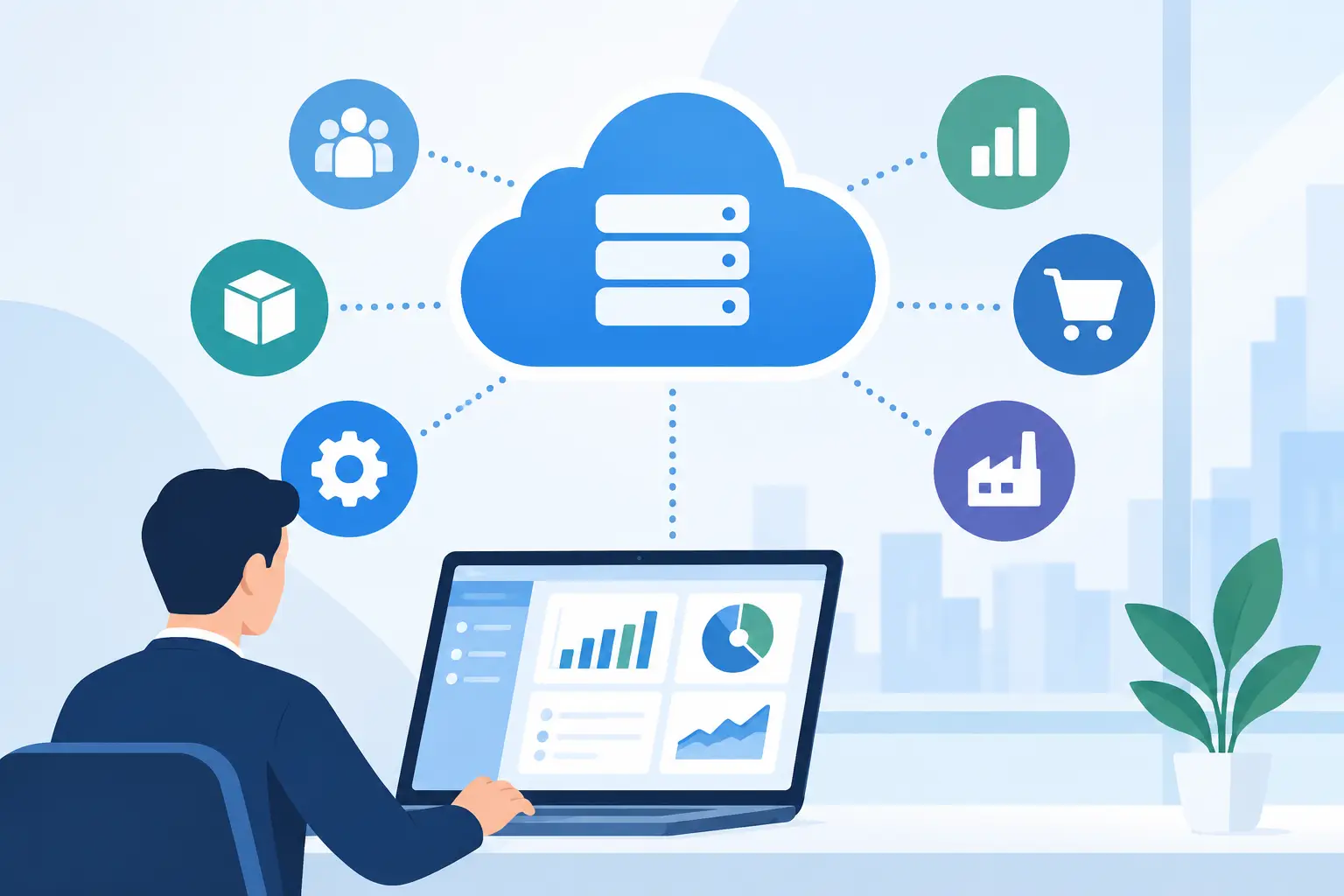
Cloud ERP gives authorised users access to current data through a browser or mobile device. A manager visiting a site, a finance team working remotely, and a warehouse supervisor on the floor can work from the same records. This does not mean every employee needs access to every financial detail. Well-configured roles and approvals ensure people see and do what their jobs require.
The benefit is faster, better-informed action. Teams can check inventory availability before promising delivery dates, review overdue receivables before approving further credit, or identify production variances while there is still time to correct them. With Power BI analytics connected to operational data, leaders can also move beyond static reports and examine trends by product, site, customer, cost centre or period.
Automation Reduces Admin Without Losing Control
Many businesses worry that automation will remove oversight. In a well-designed ERP, it does the opposite. Automation handles repeatable steps while approval rules, audit trails and exception reporting give managers clearer control over what needs attention.
Purchase requisitions can follow approval workflows. Invoices can be generated from confirmed deliveries or approved timesheets. Reorder points can create purchasing suggestions based on current stock and demand. Bank transactions can be matched against invoices rather than reconciled manually line by line.
The result is not that people become less important. Finance teams spend less time chasing paperwork and more time examining performance. Operations teams spend less time updating duplicate records and more time resolving bottlenecks. Owners gain a more reliable picture of cash, commitments and profitability.
Automation should reflect the way the business actually operates. A process manufacturer may need batch, formula and quality controls. A plantation may require harvest monitoring, field-level records and seasonal planning. A professional practice may prioritise project budgets, time capture and billing. Generic workflows can create workarounds, so configuration matters as much as the software itself.
Cloud ERP Supports Growth Across Sites and Teams
Growth often exposes the limits of disconnected systems. Opening another warehouse, adding a retail location, employing more field staff or selling through new channels introduces more transactions and more chances for information to drift apart.
Cloud-based ERP provides a common platform for multiple sites without requiring each location to maintain separate servers or software versions. New users, entities, warehouses, product lines and reporting dimensions can be added as the organisation changes. For Australian businesses with teams in regional areas, interstate locations or overseas operations, this shared access can remove a great deal of administrative friction.
Scalability does not mean every business should buy the biggest possible system on day one. The sensible approach is to implement the modules and workflows that solve the current operational issues, then extend the platform as needs develop. A business might begin with finance, sales and inventory, then add production planning, machine connectivity, labour hire administration or advanced analytics when those capabilities will deliver a clear return.
Better Traceability for Stock, Production and Compliance
When customers ask where an item came from, when it was made or who approved a transaction, searching through emails and spreadsheets is a poor answer. Cloud ERP creates a connected record from purchase through to delivery, making traceability far more practical.
In warehousing and trading, this means clearer visibility of stock by location, lot or serial number. In production environments, it can mean tracking raw materials, work orders, yields, downtime and finished goods. Where machinery or PLC data is relevant, operational readings can be connected with planning and business records rather than reviewed in isolation.
Traceability also supports compliance and sustainability reporting. Carbon accounting is becoming more relevant to suppliers, customers and boards, particularly where energy use, transport, material inputs and production processes affect emissions. Capturing better operational data does not solve every reporting obligation, but it gives the business a more credible foundation than estimates assembled at the last minute.
Security and Reliability Need Active Management
Cloud ERP is sometimes treated as less secure because it is accessed online. The reality is more nuanced. A cloud platform can provide stronger security than an ageing on-premises server, particularly when it includes managed updates, backups, role-based access and security monitoring. But cloud software is not automatically secure simply because it is cloud software.
Businesses still need strong passwords, multi-factor authentication, sensible permissions and staff training. They need a process for removing access when employees leave and reviewing who can approve payments, change supplier details or export sensitive data. A provider’s cybersecurity capability, data practices and support model should be assessed as carefully as the product features.
Reliability also depends on internet access and business continuity planning. Sites with inconsistent connectivity may need contingency procedures for critical warehouse, retail or production activity. These are manageable considerations, not reasons to avoid cloud ERP, but they should be addressed during implementation rather than after an outage.
Implementation Is the Difference Between Software and Results
Cloud ERP can be quicker to deploy than traditional server-based software, but it is not a plug-and-play replacement for every spreadsheet. The business must decide which data is reliable, which workflows should be standardised and where industry-specific configuration is essential.
Start with the operational questions that currently take too long to answer. Can the business see stock availability by site? Does finance know the real cost of a job before it closes? Can management compare actual production output with plan? Are invoices delayed because time, delivery or approval data is incomplete? These questions define the implementation priorities better than a generic feature checklist.
Staff adoption deserves equal attention. Users need practical training based on their daily tasks, not only a demonstration of every menu. A warehouse operator, project manager and finance officer will each use the system differently. Clear ownership, phased change and responsive support reduce resistance and help the platform become part of normal work.
For businesses that need a connected platform across finance, inventory, production, projects and specialised workflows, OneBusiness can be configured around the operational reality rather than forcing teams back into disconnected tools.
The right cloud ERP should make the next decision easier: whether to buy materials, schedule work, follow up a payment, move stock or investigate a variance. Start with the decisions that matter most to your operation, then build the system around the information and controls required to make them with confidence.