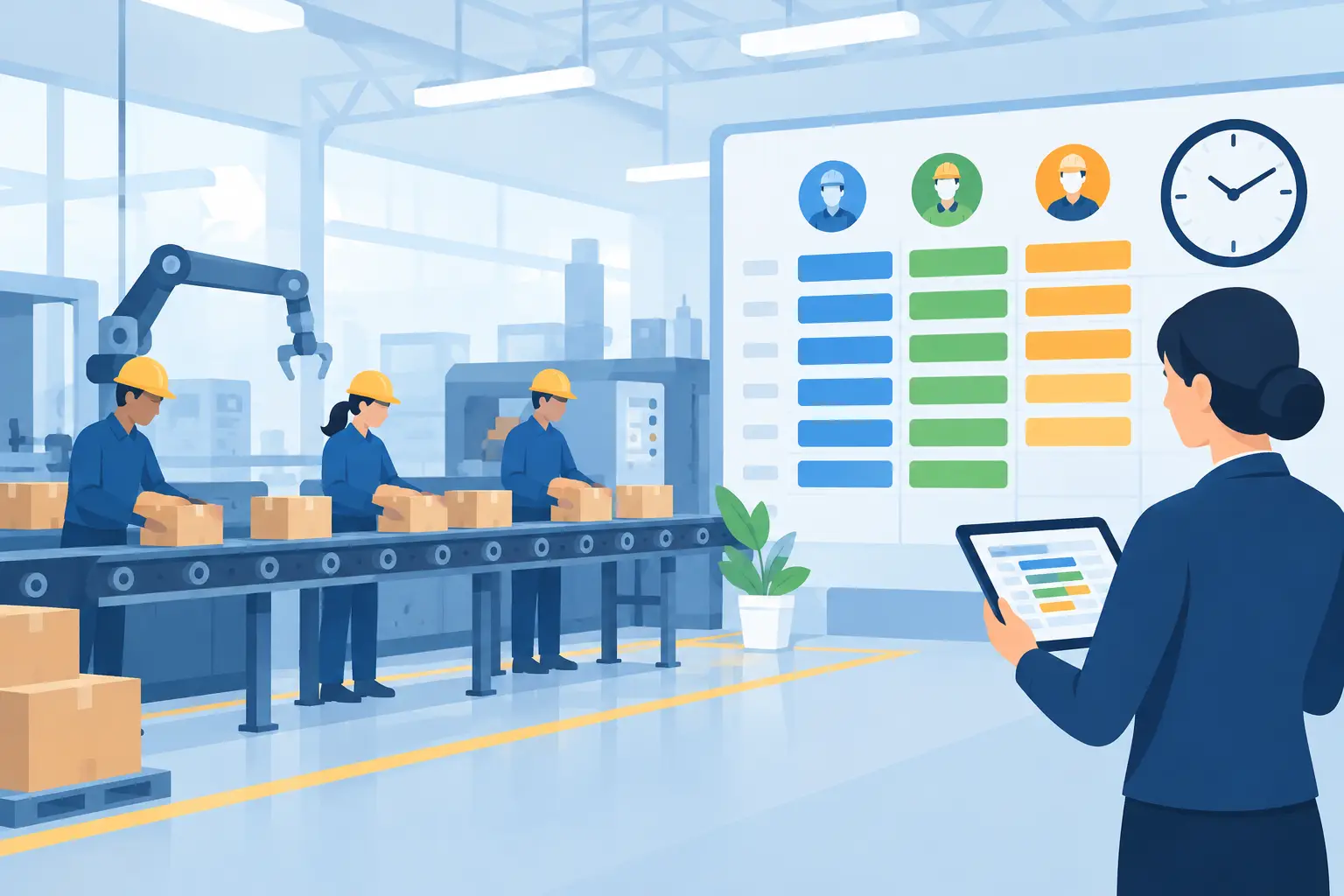

A production manager should not need to walk the floor, ring three supervisors and update a spreadsheet to find out whether an order is on track. Yet that is still how many factories operate. This is why factories use MES: to turn activity on the shop floor into timely, usable information that improves decisions before a delay becomes an expensive problem.
MES, or Manufacturing Execution System, sits between enterprise planning and physical production. It helps teams manage, monitor and record what happens as materials become finished goods. For manufacturers running complex processes, multiple work centres, regulated products or tight delivery commitments, MES creates the operational control that planning software alone cannot provide.
Why factories use MES for real-time control
An ERP system is essential for managing orders, purchasing, inventory, finance and production planning. It can tell a business what it intends to make, what materials should be available and what the order should cost. MES focuses on what is actually happening right now: which job is running, which machine is stopped, whether the correct material was issued, how much has been produced, and where quality checks are required.
Without this layer, the gap between plan and reality is often filled with paper job cards, whiteboards, spreadsheets and informal handovers. These methods can work in a small, stable operation, but they become fragile as volumes grow. A late material issue, unrecorded machine stoppage or incorrect batch setting may not appear in reporting until the end of a shift or, worse, after an order is dispatched.
MES captures production events at the source. Operators can record progress through an intuitive screen, barcode scan or mobile device. Where suitable, PLC and machine integration can automatically collect cycle counts, run time, downtime and process readings. Supervisors see exceptions as they occur instead of relying on yesterday’s report.
That visibility changes the daily conversation. Rather than asking, “What happened?”, the team can ask, “What should we do next?”
Better scheduling starts with trustworthy shop-floor data
Production schedules rarely fail because a planner lacks effort. They fail because the schedule is based on assumptions that no longer match the floor. A machine is running slower than expected, a key operator is absent, a previous order has generated extra rework, or material has not passed inspection.
MES gives planners and production leaders a clearer picture of capacity and progress. Actual run rates, labour time, downtime reasons and order completion feed back into future scheduling. Over time, this helps businesses set more realistic production standards and promise dates with greater confidence.
The benefit is not simply faster output. It is better control over trade-offs. A factory may choose to prioritise a high-value customer order, protect a constrained work centre, or run a shorter batch to reduce the risk of obsolete stock. Those decisions are stronger when the current state of production is visible all in one place.
Connecting plans, materials and execution
A useful MES does more than display machine data. It links each production order to the bill of materials, routing, work instructions, quality requirements and labour activities needed to complete it. This reduces the risk of an operator using an outdated instruction or an unapproved material substitute.
When MES is connected to inventory and ERP data, material consumption can be recorded against the job as it happens. Stock figures become more accurate, work in progress is easier to value, and finance teams have a firmer basis for costing and margin analysis. For small and mid-sized manufacturers, this connection can remove substantial manual reconciliation at month end.
Traceability is a commercial advantage, not just a compliance task
Traceability is often associated with food, pharmaceuticals, chemicals and other regulated sectors. It matters just as much in general manufacturing when customers expect evidence of quality, consistent specifications and reliable response to issues.
MES can track lot numbers, serial numbers, production dates, operator actions, machine settings and inspection results through the production process. If a quality concern arises, the business can identify affected batches quickly rather than reviewing paper records or placing all related stock on hold.
This has practical consequences. A targeted investigation can reduce waste, limit the scope of a recall and protect customer relationships. It also gives quality teams a more complete record for audits and continuous improvement.
Traceability requirements vary by industry. A simple fabrication workshop may only need job-level records, while a process manufacturer may need detailed batch genealogy and mandatory quality holds. The right MES configuration should match the actual risk and reporting requirement rather than burdening operators with unnecessary data entry.
MES helps reduce waste, rework and unplanned downtime
Factories do not improve by collecting data for its own sake. They improve when data exposes repeatable causes of loss and gives people a practical way to respond.
MES can classify downtime by reason, such as material shortage, changeover, maintenance, quality hold or operator availability. It can capture scrap and rework at the operation where they occurred, rather than recording one broad variance after the job is closed. This makes patterns easier to identify.
For example, a production team may find that a particular product generates excessive setup time on one line, or that rejects increase after a certain machine condition appears. Maintenance can then be planned around evidence instead of reacting after a breakdown. Engineering and quality teams can review the same operational record rather than debating whose spreadsheet is correct.
Machine connectivity adds value where equipment produces reliable signals. PLC integration can provide accurate run and stop information without asking operators to enter every event manually. However, automation is not always the answer. Older equipment, variable processes and manual assembly tasks may still rely on well-designed operator screens and barcode workflows. The aim is useful data with minimal friction, not technology for show.
Quality becomes part of the workflow
When quality checks sit outside production records, they are easy to delay and difficult to analyse. MES can build inspections, approvals and hold points directly into the routing. An operator cannot move a job to the next stage until the required check is completed or an authorised exception is recorded.
This supports consistency across shifts and sites. It also gives managers a clearer view of where issues originate: incoming material, a process step, a machine setting or final inspection. Instead of treating quality as a separate department’s report, MES makes it part of how work gets done.
For businesses pursuing customer certifications or managing environmental obligations, this level of control can also support carbon accounting. Accurate production quantities, material use, energy-related machine data and scrap records provide better inputs for operational emissions reporting than estimates assembled after the fact.
When MES is worth the investment
Not every factory needs a highly customised MES from day one. A low-volume operation with simple products, one or two work centres and close owner oversight may gain more from improving core inventory and production processes first. MES becomes more compelling when manual visibility is limiting growth or creating financial risk.
Common signals include frequent schedule changes, uncertain work-in-progress quantities, recurring stock discrepancies, costly rework, customer traceability requests, unreliable production reporting and disconnected machine or quality data. It is also valuable when leaders cannot see the relationship between factory performance and job profitability until too late.
Implementation should begin with the business outcomes that matter most. That may be accurate batch traceability, live job status, downtime analysis, labour capture or stronger integration between production and finance. Starting with a clear operational problem helps avoid an overly complex rollout.
Integration matters more than another standalone screen
A standalone MES can improve local shop-floor visibility, but it can also create another data silo if it is not connected to purchasing, inventory, sales, accounting and planning. Manufacturers need a reliable flow from customer demand through materials, production, dispatch and financial reporting.
A connected cloud platform can bring ERP workflows, MES capabilities, machine and PLC data, Power BI reporting and security management into a more coherent operating model. OneBusiness is designed for businesses that need this practical connection across operational and financial teams, with configuration for industry-specific production workflows.
The implementation approach matters as much as the software. Operators need simple screens that suit the pace of their work. Supervisors need alerts and exception views, not a flood of dashboards. Finance teams need production data that supports accurate inventory valuation and costing. IT managers need secure access, dependable integration and a manageable support model.
The strongest MES projects make the factory easier to run on a difficult day. When a machine stops, a batch fails inspection or an urgent order arrives, leaders can see the facts, coordinate a response and understand the cost of the decision. That is the practical value of MES: less chasing, fewer surprises and greater confidence in every production decision.