A production order can look straightforward on paper: make 500 units, use the approved materials, finish by Friday. On the factory floor, the real question is what happens between the release of that order and the finished goods receipt. What is production routing? It is the documented sequence of operations that tells your team, machines and system how a product moves through production.
For manufacturers and process businesses, routing turns a bill of materials into an executable plan. It defines where work occurs, the order in which it occurs, how long each activity should take, which resources are needed, and what must be recorded before the next step can begin. Without it, scheduling, costing and traceability often rely on tribal knowledge, whiteboards and spreadsheets that are difficult to trust when demand changes.
What is production routing and why does it matter?
A production routing is the operational path for making a product. Each route is made up of individual operations, such as cutting, mixing, machining, washing, assembly, inspection, packing or curing. For each operation, the business can specify the work centre or machine, expected setup and run time, labour requirements, instructions, quality checks and the next destination for the item.
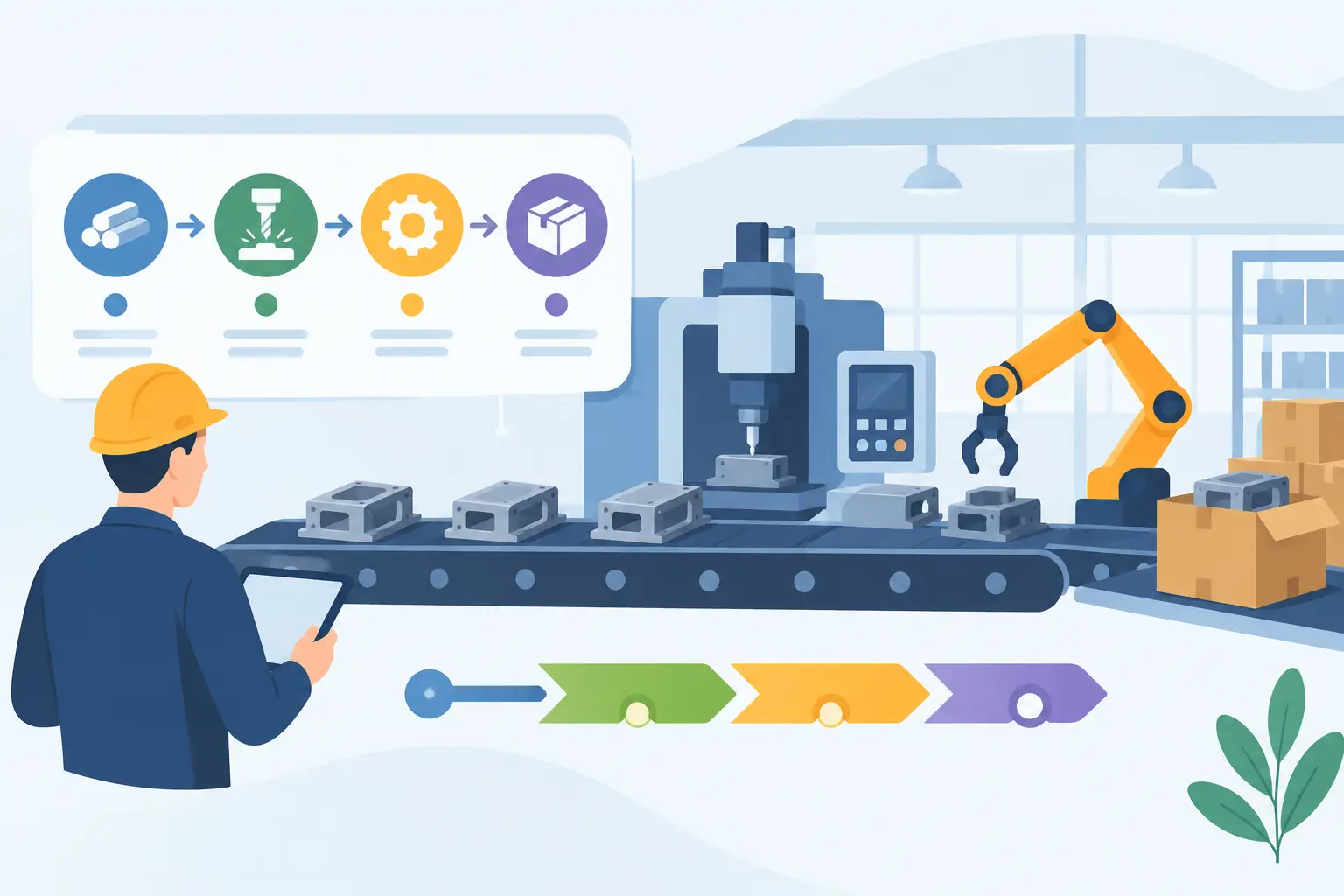
Consider a garment washing operation. A route may send a batch from receiving to sorting, washing, treatment, drying, finishing, quality inspection and packing. In a metal workshop, it might move from cutting to CNC machining, welding, grinding, painting and final inspection. The finished item is different, but the operational purpose is the same: make the flow visible and repeatable.
Routing matters because production rarely fails at the level of the finished product description. It fails in the detail. A job waits because a machine is occupied, an operator does not have the correct instructions, material is issued to the wrong stage, or an inspection result is recorded too late. A properly configured routing gives planners and supervisors a common operational record rather than several versions of the truth.
Routing, bills of materials and work orders
Production routing is often confused with a bill of materials, but they answer different questions. A bill of materials defines what goes into a product: raw materials, components, packaging and sometimes consumables. Routing defines how those inputs become the finished product.
A work order brings the two together for a specific quantity and date. It uses the bill of materials to reserve or issue stock, then uses the routing to create the required operations. That structure allows the business to track progress as the order moves through each work centre.
For example, a food processor may need ingredients, bottles, labels and cartons to make a packaged product. The bill of materials captures those items and quantities. The routing sets out blending, heating, filling, capping, labelling, carton packing and quality release. If a batch is delayed at filling, the planner can see the bottleneck and the likely impact on dispatch instead of simply seeing an order that is still open.
What a useful production route includes
A route should be detailed enough to guide daily work without becoming so complicated that nobody maintains it. Most businesses need a clear operation sequence, a nominated work centre, expected time standards and practical instructions. They also benefit from recording the labour skill required, machine capacity, inspection points, expected scrap or yield, and the materials consumed at a particular stage.
Setup time and run time deserve particular attention. Setup is the time required to prepare a machine, tool, line or work area before production starts. Run time is the time required to process each unit or batch. Separating them produces more accurate capacity plans and product costs. It also helps management see whether frequent short runs are creating a hidden cost through repeated changeovers.
The level of detail depends on the operation. A simple assembly business may use a short route with three or four operations. A tannery, plantation processor or regulated food manufacturer may need many more stages, batch controls, test results, hold points and full lot traceability. The goal is not to force every business into the same template. It is to capture the controls that matter to its product, equipment and customers.
Work centres make capacity visible
A work centre represents where an operation is performed. It may be a CNC machine, a production line, a packing bench, a wash bay, a team of technicians or a contracted process. Assigning operations to work centres lets the system calculate load against available capacity.
This is where routing becomes a planning tool rather than static documentation. If two orders both require the same curing oven on Wednesday, the schedule can expose the conflict before the floor team is forced to improvise. Planners can then change sequence, adjust shifts, subcontract a step, or renegotiate a delivery date with evidence.
Quality and traceability belong in the route
Quality checks should sit at the point where they can prevent expensive rework, not only at the end of the process. An inspection after machining can stop defective parts moving into assembly. A temperature check during processing can identify a batch issue before packaging consumes more material and labour.
When operators record completion, quantities, scrap, test readings and batch or serial details against each operation, the business gains an auditable production history. This supports customer enquiries, warranty investigation, recalls and continuous improvement. It also gives finance a better view of work in progress rather than treating production as a black box until goods are completed.
How production routing improves cost control
Standard routing provides the expected labour and machine time for a product. Combined with labour rates, machine rates and material consumption, it supports a realistic standard cost. Actual production reporting then shows where the job differed from plan.
That comparison is useful only when the route reflects reality. If an operation is missing, time standards are outdated, or a bottleneck is assigned to the wrong work centre, the costing model will create false confidence. Routings need review when new machinery is installed, product design changes, process improvements are introduced or supplier arrangements shift.
For operational leaders, the value is practical. They can identify products with excessive setup effort, recurring scrap at a particular operation, overtime driven by poor sequencing, or jobs that consistently consume more hours than quoted. Those findings support decisions about pricing, engineering changes, training and capital investment.
From paper travellers to connected production data
Paper job travellers can communicate a route, but they are slow to update and difficult to analyse. A connected ERP platform gives each team access to the same production order, operation status, inventory position and financial impact in one place. Operators can record progress at the work centre, supervisors can review exceptions, and finance can see labour, consumption and work-in-progress movements as they occur.
For businesses with industrial equipment, routing can become even more reliable when machine or PLC data is connected to the production record. Machine states, cycle counts, temperature readings or downtime events can validate production activity and highlight differences between planned and actual performance. This does not remove the need for operator input, particularly for quality checks and exceptions, but it reduces manual entry where machine data is already available.
Analytics can then turn routing data into useful management reporting: capacity by work centre, order lead time, schedule adherence, yield, downtime, labour efficiency and cost variance. Power BI dashboards are particularly valuable when managers need to compare operational performance across sites, shifts or product families without exporting and rebuilding spreadsheet reports.
Common routing mistakes to avoid
The most common mistake is designing a route around an ideal process rather than the process people actually follow. If operators routinely add an inspection, staging step or rework loop that is not in the system, planning and costing will always be incomplete.
Another issue is using one generic route for products with genuinely different production requirements. A shared route can reduce maintenance, but only where the sequence, resources and time expectations are materially similar. Where product variants require different tooling, treatments or quality controls, separate routes or controlled route versions are usually the better choice.
Businesses can also over-engineer routing. Recording every movement across the floor may burden operators without improving decisions. Start with the stages that affect capacity, cost, quality, compliance or customer delivery. Add detail when it produces a clear operational benefit.
Building production routing into daily operations
Start by walking the process with the people who perform it. Map the actual sequence, including queue time, checks, hand-offs, rework and common delays. Then identify the work centres, required resources and realistic timing for each operation. Historical job data is helpful, but it should be tested against current staffing, equipment and batch sizes.
Next, connect the route to bills of materials, work orders, inventory movements and quality records. Pilot it on a product family before applying it across the operation. The pilot should test whether the route is easy for operators to use, whether reporting is meaningful, and whether planners can act on the capacity information it produces.
OneBusiness can configure production routing alongside inventory, purchasing, finance, machine connectivity and reporting, so teams do not have to reconcile separate production and accounting records. The right design remains specific to the business, however. A job shop, a process manufacturer and a plantation packing operation will each need different controls.
The most useful routing is not the one with the most fields. It is the one your team can follow every day, while giving managers enough real-time evidence to make the next production decision with confidence.