
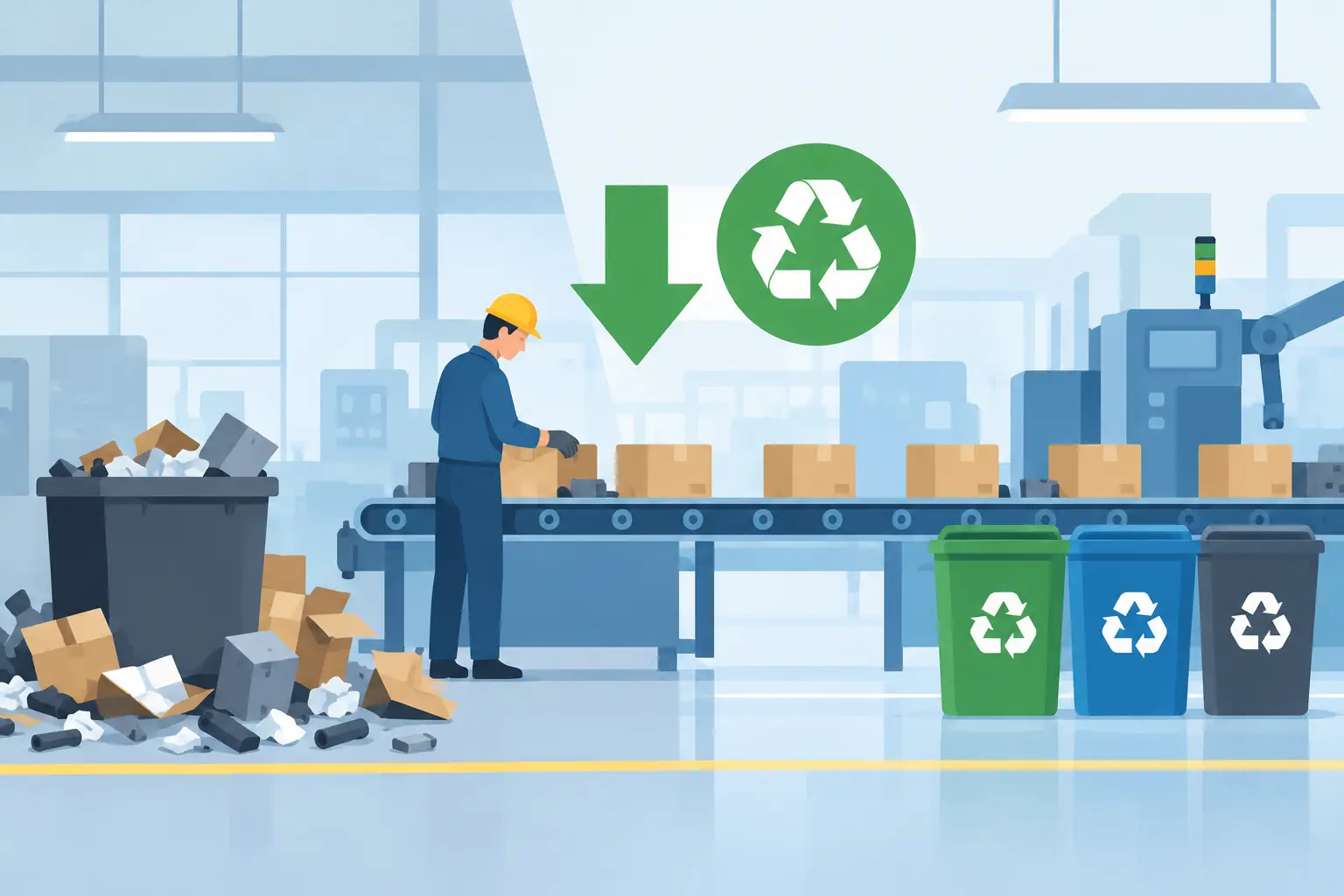
A bin of rejected parts, excess trim on a cutting table or a batch that misses specification can look like a routine cost of doing business. It is rarely just that. The best ways to reduce production waste start by treating waste as operational data: a signal that material, labour, machines, quality checks or production plans are not working together as they should.
For manufacturers, processors, garment washers, tanneries and plantation operators, small losses compound quickly. Waste ties up working capital, creates disposal costs, raises carbon exposure and makes delivery performance less predictable. Reducing it requires more than asking teams to be careful. It requires connected processes, accurate records and decisions made while there is still time to act.
Start by measuring waste at the point it occurs
Many businesses can report total scrap at the end of the month, but that is too late to prevent the next loss. A useful waste programme records what was lost, where it happened, why it happened and what it cost. This means capturing waste against the production order, work centre, machine, operator, shift, material batch and reason code.
The reason codes need to be practical. “Other” might feel convenient, but it hides the pattern. Separate codes for damaged raw material, incorrect settings, calibration issues, overproduction, expired stock, cutting errors, contamination and customer specification changes will produce far more useful information.
Measure both quantity and value. Ten kilograms of low-cost offcut is not the same commercial problem as ten kilograms of premium leather, chemicals or specialised food ingredients. Finance and operations should use the same source of truth, so the cost of waste is visible in inventory valuation, production variance and margin reporting.
Set a baseline before setting a target
Do not begin with an arbitrary target such as “cut waste by 20 per cent”. First establish the normal loss rate for each product, recipe, production line or process stage. Some yield loss is inherent in processing, trimming and setup. The objective is to distinguish expected loss from avoidable loss.
Once a baseline is in place, review yield by product and shift. A sudden change may point to a supplier quality issue, a worn tool, an inaccurate bill of materials or a training gap. Power BI dashboards can make these patterns visible without requiring managers to work through disconnected spreadsheets.
Improve planning before material reaches the floor
Overproduction is one of the most expensive forms of waste because it often looks like finished goods rather than rubbish. When demand is uncertain, businesses may run larger batches to protect against stock-outs or minimise changeover time. That decision can create slow-moving inventory, expiry risk, rework and eventual write-offs.
Better production planning balances confirmed orders, forecast demand, available stock, lead times, capacity and minimum batch constraints. It also needs to account for material shelf life, customer-specific specifications and known yield rates. For process industries, a plan that ignores actual batch yields can leave teams scrambling for extra material or carrying an unexpected surplus.
Smaller batches can reduce obsolete stock and make quality problems easier to contain. However, they may increase changeover time and unit costs. The right approach depends on product volatility, setup effort, storage limits and the cost of being wrong. A connected ERP system helps planners test these trade-offs using live inventory and demand data rather than assumptions.
Tighten inventory and batch traceability
Waste often begins in the warehouse. Material can expire, be stored incorrectly, get issued to the wrong job or be substituted without recording the change. These errors become harder to resolve once materials are mixed, cut, washed or consumed in a production batch.
Use barcode or mobile scanning to confirm receipts, bin locations, issues and returns. Apply first-expiry, first-out rules where shelf life matters, and first-in, first-out where ageing stock is the main concern. Batch and lot traceability should show exactly which material was used in each finished product, including supplier, receipt date and test results where relevant.
Accurate bills of materials and recipes are equally important. If the planned consumption is wrong by a small amount, operators may repeatedly over-issue material to keep production moving. Review standard quantities after product changes, supplier substitutions and improvements to cutting or process methods. The production floor should not have to compensate for outdated master data.
Use machine data to catch loss earlier
Manual production records have value, but they cannot always reveal a machine running outside its expected range. PLC and machine connectivity can capture run time, downtime, temperature, pressure, speed, cycle counts and rejection signals as production happens.
For example, a gradual rise in rejects after a certain number of cycles may indicate tool wear. A temperature variation may explain inconsistent curing, drying or washing results. In a plantation or processing environment, moisture readings may highlight storage or handling conditions that will reduce usable yield.
This data is most valuable when it is linked to production orders and quality results. A manager should be able to see whether a particular line, machine setting, material batch or shift is associated with higher scrap. AI and anomaly detection can help flag unusual patterns, but the operational team still needs clear workflows for checking the cause and approving corrective action.
Build quality checks into the process, not just the final inspection
Final inspection prevents defective goods from reaching customers, but it does little to recover the labour and material already consumed. Quality checks at critical control points reduce the size of a failed batch and make root causes easier to identify.
The right checkpoints vary by industry. A garment operation may check fabric shrinkage and colour consistency before cutting. A food or chemical processor may verify ingredient weights and temperatures during mixing. A metal or component manufacturer may inspect the first-off piece after a changeover, then sample at defined intervals.
Give operators straightforward digital instructions and a way to record results immediately. If a reading falls outside tolerance, the system should prompt an action such as hold the batch, notify a supervisor, inspect the machine or complete a corrective action record. This approach may feel slower at first, but it is generally less costly than discovering a full day’s output needs rework or disposal.
Reduce rework by making standard work usable
Rework is often treated separately from waste because some product can be recovered. It still consumes capacity, labour, energy and materials. Frequent rework is also a warning that standard work is unclear, impractical or not consistently followed.
Document the best-known method for setup, material handling, machine settings and quality checks. Keep instructions accessible at the work centre, using the language and level of detail operators need. When a process changes, update the instruction and training record together. An old printed procedure beside a new machine setting is a predictable source of variation.
Managers should also distinguish between operator error and process design. If several capable people make the same mistake, redesign the workflow. A scan validation, preset machine programme or system-controlled material issue may remove the opportunity for error entirely.
Find a productive use for unavoidable residuals
Not every residual can be eliminated. Trimmings, offcuts, wash sludge, by-products and unavoidable yield losses may remain part of a process. The opportunity is to segregate them properly and determine whether they can be reused internally, returned to a supplier, sold as a by-product or sent to a recycling partner.
This only works when materials are kept clean and traceable. Mixed waste has less value and may create compliance issues. Record the weight, destination and disposal cost of each stream, including transport where applicable. These records support carbon accounting as well as cost control, particularly where customers or regulators are asking for better environmental reporting.
Give teams ownership and a fast feedback loop
Waste reduction cannot sit only with the production manager. Procurement affects incoming quality, planning affects batch sizes, maintenance affects machine condition, warehouse teams affect stock integrity, and finance confirms the commercial impact. A cross-functional review is useful when it focuses on a small number of material problems rather than becoming a broad monthly discussion.
Review the highest-value waste events, repeated reason codes and emerging changes in yield. Assign an owner, a due date and a measure of success. Then report the result back to the people on the floor. When teams can see that a reported issue led to a better setting, clearer instruction or supplier change, they are more likely to keep recording accurate information.
OneBusiness can bring production, inventory, finance, machine data and analytics together in one place, helping operational leaders trace losses from the factory floor through to margin and carbon reporting. The technology matters, but the purpose is practical: make the next production decision with better evidence.
The most useful improvement is usually not the biggest project. Start with the waste stream that has the clearest cost, make it visible during the shift, and give the responsible team authority to correct it. That is how reduced waste becomes a repeatable operating habit rather than a short-lived campaign.