
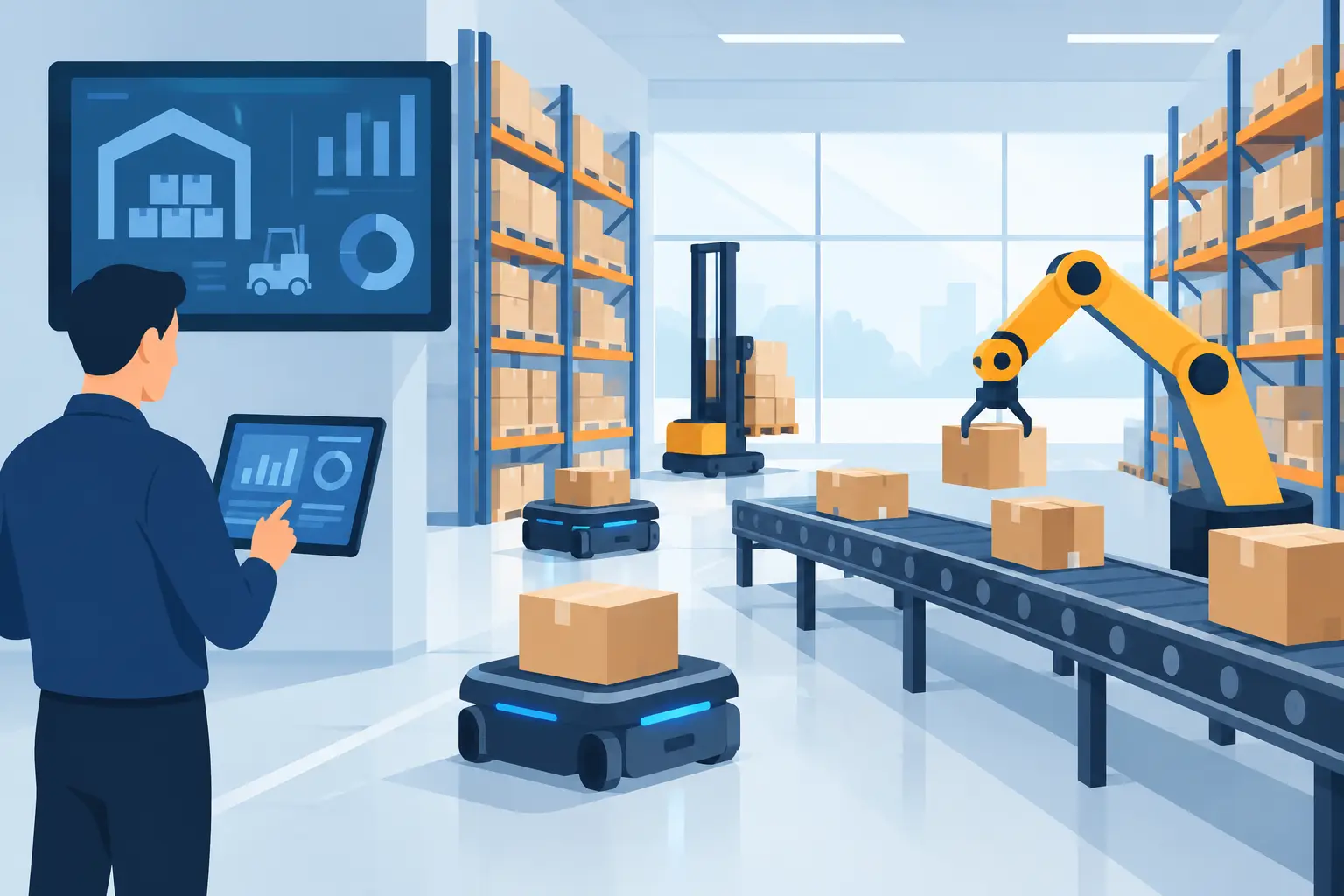
A missing pallet, an incorrect pick, or a stock figure that does not match the warehouse floor can quickly become a customer service and cash-flow problem. Warehouse automation gives operational teams a more reliable way to manage those moments. It connects physical movements, staff activity and inventory records so decisions are based on current information rather than paperwork, delayed data entry or assumptions.
For Australian manufacturers, distributors, retailers and processing businesses, the goal is not simply to add more technology. The goal is to move goods accurately, use labour well, maintain traceability and keep finance, purchasing, production and sales working from the same numbers.
What warehouse automation means in practice
Warehouse automation is the use of connected software, data capture tools, equipment and workflow rules to reduce manual warehouse tasks and improve control. It can be as practical as barcode scanning at receiving and dispatch, or as advanced as conveyors, autonomous mobile robots, machine-connected production lines and AI-supported replenishment planning.
The right level depends on the operation. A growing wholesale business may gain immediate value from mobile scanning, bin locations and automated purchase suggestions. A high-volume manufacturer may need stock movements triggered by production orders, PLC data from machinery and real-time consumption of raw materials. Both are forms of automation when they remove repetitive work and make the record of stock more dependable.
Automation should not be confused with replacing every warehouse worker. Experienced warehouse staff still make judgement calls about damaged goods, urgent orders, substitutions and exceptions. A well-designed system removes unnecessary administration so those people can focus on work that needs their attention.
Where warehouse automation delivers value
The first improvement is accuracy. When staff scan an item, location and quantity at the point of activity, the inventory record updates immediately. That reduces double handling and helps prevent the familiar problem of selling stock that is unavailable, while slow-moving stock sits unnoticed in another location.
Receiving becomes more controlled as well. Purchase orders can guide staff through expected quantities, lot numbers, serial numbers, expiry dates and quality checks. If goods differ from the order, the discrepancy can be recorded before it creates an invoice dispute or production delay. For businesses handling food, chemicals, agricultural inputs, leather, garments or regulated products, that traceability is often essential rather than optional.
Picking and dispatch are another common source of gains. The system can direct staff to the correct bin, group work by route or order priority, and confirm that the right goods have been packed. This supports faster fulfilment without relying on staff to remember every item location. It also makes it easier to investigate a short delivery or customer claim because the transaction history is available in one place.
Better planning follows when warehouse data is timely. Purchasing teams can see what has been received, committed to sales orders, consumed in production and available to promise. Finance can value stock with greater confidence. Managers can identify excess inventory, repeated adjustments and areas where warehouse labour is being absorbed by avoidable rework.
Reliable data comes before advanced equipment
Automated storage systems, robots and conveyors can be valuable, but they will not correct inaccurate item records or poorly managed locations. If units of measure are inconsistent, stock is stored outside nominated bins, or users bypass transactions, automation can make confusion move faster.
Start with clear product masters, defined warehouse zones, sensible replenishment rules and agreed processes for receiving, transfers, picking, returns and stocktakes. The system should reflect how the operation genuinely works, including batch tracking, quarantine locations, customer-specific packing rules or production staging areas where required.
Choosing the right warehouse automation tools
The best starting point is usually the process with the highest combination of volume, risk and repetition. A business that loses time searching for stock may begin with barcode labels, mobile devices and bin-level visibility. A business with frequent dispatch errors may focus on scan verification at picking and packing. A manufacturer with costly material variances may prioritise machine-connected consumption reporting and production issue controls.
Useful technologies can include barcode or RFID scanning, mobile warehouse applications, label printing, weigh scales, automated replenishment, pick-to-light systems, conveyors, automated guided vehicles and industrial sensors. Not every tool suits every warehouse. RFID, for example, can speed up high-volume tracking but may be unnecessary for a lower-volume operation with disciplined barcode scanning. Robotics can improve throughput in a stable, high-volume environment, but layout changes, irregular product sizes and seasonal demand may make a more flexible approach more sensible.
Integration matters as much as the device itself. A scanner that updates only a standalone warehouse application can create more reconciliation work if accounting, sales and production systems remain separate. The stronger approach is to have warehouse activity update inventory, purchasing, customer orders, production planning and financial records through the same connected platform.
For operationally complex businesses, this connection can extend beyond stock movements. Machine and PLC integration can capture production counts or material consumption from equipment. Power BI reporting can show order turnaround, stock ageing, fill rates and adjustment trends. Carbon accounting can use better activity data to support more credible operational reporting. These capabilities are most useful when they support a clear decision, not when they are added simply because they are available.
Implementing warehouse automation without disrupting operations
A successful project starts on the warehouse floor. Map the current flow from goods receipt to putaway, replenishment, picking, packing, dispatch, returns and stock adjustment. Speak with the people doing the work. They will usually know where labels fail, where paperwork is duplicated and which exceptions consume the most time.
Set practical measures before changing the process. These may include inventory accuracy, picking accuracy, order cycle time, lines picked per hour, on-time dispatch, stock adjustment value and the time needed for a stocktake. A baseline gives management a fair way to judge whether the change is working.
It is often better to phase the rollout. Begin with one site, warehouse zone or transaction type, test the labels and workflows, then expand. This gives staff time to build confidence and gives the project team an opportunity to correct problems before they affect the whole operation. During peak periods, avoid introducing major process changes unless there is a strong operational reason to do so.
Training should cover more than which buttons to press. Staff need to understand why a scan matters, when an exception should be recorded and who owns the next action. Clear permissions are equally important. Not every user should be able to adjust stock, change a batch number or override a dispatch check without approval.
Cybersecurity also deserves attention. Mobile devices, warehouse Wi-Fi, integrations and cloud applications expand the operational technology environment. Device management, user access controls, multi-factor authentication, backups and monitoring should be planned as part of the implementation, not added after a problem occurs.
Connecting warehouse activity to the wider business
A warehouse performs better when it is not treated as a separate back-room function. Sales needs reliable availability dates. Procurement needs reorder signals based on demand and lead times. Production needs materials issued to the right job. Finance needs accurate inventory valuation and cost movements. Management needs a clear view of performance across sites, departments and product lines.
A connected ERP platform makes this possible by maintaining one source of operational and financial data. For example, a confirmed receipt can update stock on hand and supplier records; a production transaction can reduce component inventory and add finished goods; a completed dispatch can update the sales order and trigger invoicing. That reduces spreadsheet reconciliation and helps teams act on the same version of events.
OneBusiness is designed for this connected operating model, combining warehouse and inventory control with accounting, sales, production planning, project workflows, analytics and configurable industry processes. The value is not in having more screens. It is in making each warehouse transaction useful across the business.
Keep improving after go-live
Warehouse automation is not a one-time technology purchase. Review the data regularly to find patterns: repeated short picks, frequent emergency replenishments, slow receiving, high adjustment rates or locations that create unnecessary travel. Some issues will require a system rule or layout change. Others may point to supplier performance, inaccurate bills of materials or demand planning gaps.
The most effective warehouses use automation to make daily work easier and operational decisions clearer. Start with the points where errors and delays cost the most, build dependable data habits, and expand only when the next investment has a defined operational purpose. That creates control that can grow with the business rather than a collection of disconnected tools.